Home
Class 10
MATHS
In the figure given below, ABCD is a squ...

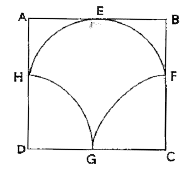
In the figure given below, ABCD is a square of side `14` cm with E,F,G and H as the mid points of sides. The area of EFGH is :

A

`44 cm^(2)`

B

`49 cm^(2)`

C

`98 cm^(2)`

D

`(49pi)/(2)cm^(2)`

Text Solution

Verified by Experts

The correct Answer is:

C
Promotional Banner

Topper's Solved these Questions

  • SAMPLE PAPER 1

    EDUCART PUBLICATION|Exercise Section -C|10 Videos
  • SAMPLE PAPER 1

    EDUCART PUBLICATION|Exercise Section -A|20 Videos
  • SAMPLE PAPER 07

    EDUCART PUBLICATION|Exercise SECTION -C|10 Videos
  • SAMPLE PAPER 10

    EDUCART PUBLICATION|Exercise SECTION-C|10 Videos

Similar Questions

Explore conceptually related problems

In the figure given below, ABCD is a square of side 14 cm with E, F, G and H as the mid points of sides AB, BC, CD and DA respectively. The area of the shaded portion is

In the figure given below, ABCD is a square of side 7 cm. BD is an arc of a circle of radius AB.

In the figure given below, ABCD is a square of side 10 cm and a circle is inscribed in it. Find the area of the shaded part as shown in the figure.

In the figure given below ABCD is a square of side 5 cm and all the four circles are of equal radius. What is the area of the shaded region ?

In the given figure, ABCD is a square of side 14cm. E and F are mid points of sides AB and DC respectively. EPF is a semicircle whose diameter is EF. LMNO is a square. What is the area (in cm^2 ) of the shaded region? दी गई आकृति में, ABCD 14 सेमी. भुजा वाला एक वर्ग है। E तथा F क्रमश: AB तथा DC भुजा के मध्य बिन्दु है। EPF, एक अर्धवृत्त है जिसका व्यास EF है। LMNO एक वर्ग है। छायांकित भाग का क्षेत्रफल ( सेमी^2 में) क्या है?

In the figure given below, ABCD is a square of side 4 cm. Two quadrants of a circle with B and D as centres are draw. The radius of each of the quadrants is 4cm. What is the area of the shaded portion?

in the adjoining figure ABCD is a square of side 14 cm. Find the radius of the circle

In the figure given below,ABC is an equilateral triangle.D,E,F,G,H and I are the trisector points of the sidesas shown.If the side of the triangle ABC is 6cm, then the area of the regular hexagon DEFGHI is

In the figure given below, ABCD is a square of side 4 cm. Quadrants of a circle of diameter 2 cm are removed from the four corners and a circle of diameter 2 cm is also removed. What is the area of the shaded region ?

EDUCART PUBLICATION-SAMPLE PAPER 1-Section -B
  1. If sum of two numbers is 1215 and their HCF is 81, then the possible ...

    Text Solution

    |

  2. Given below is the graph representing two linear equations by lines A...

    Text Solution

    |

  3. If tan alpha+cotalpha=2, then tan^(20)alpha+cot^(20)alpha =

    Text Solution

    |

  4. Solve: 217 x+131 y=913 131 x+217 y=827

    Text Solution

    |

  5. The LCM of two prime numbers p and q (p>q) is 221. Find the value of ...

    Text Solution

    |

  6. A card is drawn at random from a well shuffled deck of playing cards. ...

    Text Solution

    |

  7. Two dice are rolled simultaneously . Find the probability of ge...

    Text Solution

    |

  8. If 1+sin^2alpha=3sinalphacosalpha, then the values of cotalpha are

    Text Solution

    |

  9. The vertices of a parallelogram in order are A(1,2), B (4,y), C (x,6) ...

    Text Solution

    |

  10. In the given figure, /ACB=/CDA, AC=8 cm, AD=3 cm, then BD is :

    Text Solution

    |

  11. The equation of the perpendicular bisector of line segment joining po...

    Text Solution

    |

  12. In the given figure, D is the mid - point of BC, then the value of (c...

    Text Solution

    |

  13. The smallest rational number by which 1/3 should be multiplied so ...

    Text Solution

    |

  14. In the following figure (not to scale), ABC is a right isosceles trian...

    Text Solution

    |

  15. Point P divides the line segment joining the points A(-1,\ 3) and B...

    Text Solution

    |

  16. In the figure given below, ABCD is a square of side 14 cm with E,F,G a...

    Text Solution

    |

  17. Five congruent circles of radius 1 cm each, intersect in such a way th...

    Text Solution

    |

  18. If 2 and (1)/(2) are the zero of px^(2)+5x+r, then :

    Text Solution

    |

  19. The circumference of a circle is 100 cm. The side of a square inscribe...

    Text Solution

    |

  20. The numbers of solutions of 3^(x+y)=243 and 243^(x-y)=3 is :

    Text Solution

    |
