Home
Class 12
PHYSICS
vec(E ) due to uniformly charged sphere ...

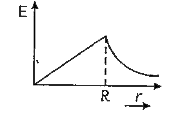
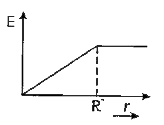
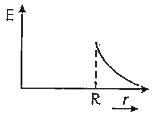
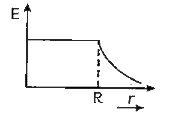
`vec(E )` due to uniformly charged sphere of radius R as a function of distance from its centre is represented by

A

B

C

D

Text Solution

AI Generated Solution

The correct Answer is:

To find the electric field \( \vec{E} \) due to a uniformly charged sphere of radius \( R \) as a function of the distance \( r \) from its center, we need to consider two cases: when the point of interest is inside the sphere (i.e., \( r < R \)) and when it is outside the sphere (i.e., \( r \geq R \)). ### Step 1: Electric Field Inside the Sphere (\( r < R \)) 1. **Gauss's Law**: We apply Gauss's Law, which states that the electric flux through a closed surface is equal to the charge enclosed divided by the permittivity of free space (\( \epsilon_0 \)). \[ \Phi_E = \oint \vec{E} \cdot d\vec{A} = \frac{Q_{\text{enc}}}{\epsilon_0} \] 2. **Choose a Gaussian Surface**: For a point inside the sphere, we choose a Gaussian surface that is a sphere of radius \( r \) (where \( r < R \)). 3. **Charge Enclosed**: The charge enclosed by this Gaussian surface can be found using the volume charge density \( \rho \): \[ Q_{\text{enc}} = \rho \cdot V = \rho \cdot \frac{4}{3} \pi r^3 \] where \( \rho = \frac{Q}{\frac{4}{3} \pi R^3} \) (the total charge \( Q \) is uniformly distributed over the volume of the sphere). 4. **Substituting Charge into Gauss's Law**: \[ \Phi_E = E \cdot 4\pi r^2 = \frac{\rho \cdot \frac{4}{3} \pi r^3}{\epsilon_0} \] \[ E \cdot 4\pi r^2 = \frac{\left(\frac{Q}{\frac{4}{3} \pi R^3}\right) \cdot \frac{4}{3} \pi r^3}{\epsilon_0} \] 5. **Solving for \( E \)**: \[ E = \frac{Q}{4\pi \epsilon_0 R^3} r \] Thus, the electric field inside the uniformly charged sphere is: \[ \vec{E} = \frac{Q}{4\pi \epsilon_0 R^3} r \hat{r} \] ### Step 2: Electric Field Outside the Sphere (\( r \geq R \)) 1. **Gauss's Law**: Again, we apply Gauss's Law for a point outside the sphere. 2. **Choose a Gaussian Surface**: For \( r \geq R \), we choose a spherical Gaussian surface of radius \( r \). 3. **Charge Enclosed**: The total charge \( Q \) of the sphere is enclosed by this Gaussian surface: \[ Q_{\text{enc}} = Q \] 4. **Substituting Charge into Gauss's Law**: \[ \Phi_E = E \cdot 4\pi r^2 = \frac{Q}{\epsilon_0} \] 5. **Solving for \( E \)**: \[ E = \frac{Q}{4\pi \epsilon_0 r^2} \] Thus, the electric field outside the uniformly charged sphere is: \[ \vec{E} = \frac{Q}{4\pi \epsilon_0 r^2} \hat{r} \] ### Summary of Results - For \( r < R \): \[ \vec{E} = \frac{Q}{4\pi \epsilon_0 R^3} r \hat{r} \] - For \( r \geq R \): \[ \vec{E} = \frac{Q}{4\pi \epsilon_0 r^2} \hat{r} \]

To find the electric field \( \vec{E} \) due to a uniformly charged sphere of radius \( R \) as a function of the distance \( r \) from its center, we need to consider two cases: when the point of interest is inside the sphere (i.e., \( r < R \)) and when it is outside the sphere (i.e., \( r \geq R \)). ### Step 1: Electric Field Inside the Sphere (\( r < R \)) 1. **Gauss's Law**: We apply Gauss's Law, which states that the electric flux through a closed surface is equal to the charge enclosed divided by the permittivity of free space (\( \epsilon_0 \)). \[ \Phi_E = \oint \vec{E} \cdot d\vec{A} = \frac{Q_{\text{enc}}}{\epsilon_0} \] ...
Promotional Banner

Topper's Solved these Questions

  • SAMPLE PAPER 6

    EDUCART PUBLICATION|Exercise Section-B|24 Videos
  • SAMPLE PAPER 6

    EDUCART PUBLICATION|Exercise Section-C|6 Videos
  • SAMPLE PAPER 5

    EDUCART PUBLICATION|Exercise SECTION - C|6 Videos
  • SAMPLE PAPER 7

    EDUCART PUBLICATION|Exercise SECTION-C|6 Videos

Similar Questions

Explore conceptually related problems

The electric field due to uniformly charged sphere of radius R as a function of the distance from its centre is represented graphically by

If the potential at the center of a uniformly charged sphere of radius R is V then electric field at a distance r from the center of sphere will be ( r lt R ) : -

If the potential at the centre of a uniformly charged hollow sphere of radus R is V, then electric field at a distance r from the centre of sphere will be (rgtR) .

The electric intensity due to a uniformly charged infinite cylinder of radius R , at a distance r(gt R) , from its axis is proportional to

A nonconducting sphere with radius a is concentric with and surrounded by a conducting spherical shell with inner radius b and outer radius c. The inner sphere has a negative charge uniformly distributed throughout its volume, while the spherical shell has no net charge. The potential V (r) as a function of distance from the center is given by

The maximum electric field intensity on the axis of a uniformly charged ring of charge q and radius R is at a distance x from the centre of the ring.The value of x is

The electrostatic potential of a uniformly charged thin spherical shell of charge Q and radius R at a distance r from the centre
