Home
Class 12
PHYSICS
Same equipotential lines distributed in ...

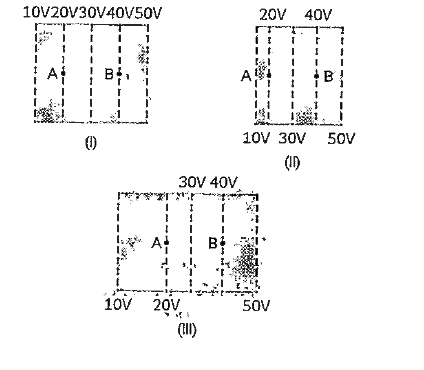
Same equipotential lines distributed in space are shown below. A charged object moves from A to B

A

Work done is same in fig (I), (II) nad (III)

B

Work done is greatest in fig (I)

C

Work done is least in fig (II)

D

Work done in fig (III) is greater then fig (II) but equal to that in fig (I)

Text Solution

Verified by Experts

The correct Answer is:

A

Work done is given by `W_(12)= q(V_(2)-V_(1))`
Hence, the initial and final potential is same in all the figure.
Promotional Banner

Topper's Solved these Questions

  • SAMPLE PAPER 6

    EDUCART PUBLICATION|Exercise Section-C|6 Videos
  • SAMPLE PAPER 6

    EDUCART PUBLICATION|Exercise Section-C|6 Videos
  • SAMPLE PAPER 5

    EDUCART PUBLICATION|Exercise SECTION - C|6 Videos
  • SAMPLE PAPER 7

    EDUCART PUBLICATION|Exercise SECTION-C|6 Videos

Similar Questions

Explore conceptually related problems

Figure shows some equipotential lines distributed in space. A charged object is moved from point A to point 5 .

There are infinite equipotential lines all parallel to BC in a right angled triangular region ABC as shown in the figure. All the points on a line have the same potential proportional to the length of the line. A positive charge is moved from A to B and C separately to do work. W_(AtoB) & W_(AtoC) , respectively, then

In the following figure, equipotential lines are shown

Two charges +Q each are fixed at points C and D. Line AB is the bisector line of CD. A third charge +q is moves from A to B, then from B to C

The position-time graph of an object moving in a straight line is shown below. The object has zero velocity at

A charge is moved in an electric field of a fixed charge distribution from point A to another point B slowly. The work done by external agent in doing so is 100J . What is the change in potential energy of the charge as it moves from A to B ? What is the work done by the electric field of the charge distribution as the charge moves from A to B ?

Equipotential sufaces are shown in figure a and b the field in

EDUCART PUBLICATION-SAMPLE PAPER 6-Section-B
  1. Current drawn from the cell is maximum when:

    Text Solution

    |

  2. If the battery and galvanometer are interchanged then the deflection i...

    Text Solution

    |

  3. Thermal compensation in wheatstone bridge can be provided by

    Text Solution

    |

  4. Same equipotential lines distributed in space are shown below. A charg...

    Text Solution

    |

  5. For any circuit, number of independent equations containing emf's, res...

    Text Solution

    |

  6. If emf and current in the circult is given by e= E(0) sin omega t i=...

    Text Solution

    |

  7. Capacitance of a capacitor A, when a dielectric is placed between the ...

    Text Solution

    |

  8. Find the capacitance of the circuit

    Text Solution

    |

  9. If we pull apart the plates of parallel plate capacitor then,

    Text Solution

    |

  10. A balanced wheat stone bridge has resistance P= 10Omega, Q= 20Omega R=...

    Text Solution

    |

  11. If 10muC charge exists at centre of a square ABCD and 2mu C point char...

    Text Solution

    |

  12. The force of attraction between two charges at distance r, when the ai...

    Text Solution

    |

  13. Calculate the coulomb force between two electrons separated by 0.8xx10...

    Text Solution

    |

  14. In vacuum, a parallel plate capacitor has capacitance C(0). New capaci...

    Text Solution

    |

  15. If phi(1) and phi(2) are normal of flux entering and leaving an enclos...

    Text Solution

    |

  16. Assertion (A) : As temperature of wire increases, drift velocity of el...

    Text Solution

    |

  17. Assertion (A) : Wire of a heater has high melting point and resistance...

    Text Solution

    |

  18. Assertion (A) : Real Transformers are 100% efficient. Reason (R ): I...

    Text Solution

    |

  19. Assertion (A) : No net power is consumed by a conductor in half cycle....

    Text Solution

    |

  20. Assertion (A) : Electrons have no thermal velocity in a conductor. R...

    Text Solution

    |
