Home
Class 12
PHYSICS
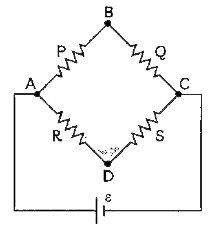
If a galvanometer is connected between B...


If a galvanometer is connected between B and D determine the direction of current :

A

D to B

B

B to D

C

First B to D then D to B

D

Depends on resistance of galvanometer

Text Solution

Verified by Experts

The correct Answer is:

A

As `V_(D) gt V_(C)`
Direction will be D to B.
Promotional Banner

Topper's Solved these Questions

  • SAMPLE PAPER - 8

    EDUCART PUBLICATION|Exercise Section B|24 Videos
  • CBSE TERM-1 SAMPLE PAPER 1

    EDUCART PUBLICATION|Exercise SECTION-C|6 Videos
  • SAMPLE PAPER 04 (SOLVED)

    EDUCART PUBLICATION|Exercise SECTION-C|6 Videos

Similar Questions

Explore conceptually related problems

A Wheatstone bride is almost balanced with point C grounded. Calculate (a) the potential of point B (b) the potential of point D (c) If a galvanometer is connected between B and D, what is the direction of current through it ? (d) For what value of the resistance BC would the bridge be in balanced state ?

The current between B and D in the given figure is

The magnetic field associated with a current-carrrying conductor is in anticlockwise direction. If the conductor was held along the east-west direction, what will be the direction of current through it ? Name and state the rule applied to determine the direction of current ?

A resistance of 4 Omega is connected in parallel to a galvanometer of resistance 396 Omega . Find the fraction of the total current passing through the galvanometer and the fraction of the total current passing through the shunt.

When a galvanometer is shunted with a 4 Omega resistance, the deflection is reduced to one-fifth. If the galvanometer is further shunted with a 2 Omega wire, determine current in galvanometer now if initially current in galvanometer is I_(0) (given main current remains same).

Connect the circuit as shown in figure Connect a copper wire, thicker and straight as compared to the connecting wires, between A and B. Keep a magnetic needle adjacent to the wire. Keep the plug key open in the circuit and observe the direction of the needle. Close the plug key and observe the direction of the needle. What do you notice? Now interchange the connecting wires connected to the cell and observe the direction of the magnetic needle. Do you notice any relation between the direction of current and position of the needle? What do you learn from this experiment?

In the circuit shown if a conducting wire is connected between points A and B, the current in this wire will :-
