Home
Class 14
PHYSICS
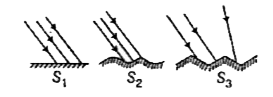
Light is falling on the surfaces S(1),S(...

Light is falling on the surfaces `S_(1),S_(2) and S_(3)` as shown below.

The surfaces on which the angle of incidence is equal to the angle of reflection are

A

`S_(1) and S_(3)`

B

All the three surfaces

C

`S_(1) and S_(2)`

D

`S_(2) and S_(3)`

Text Solution

Verified by Experts

The correct Answer is:

B

All the three surfaces
Promotional Banner

Similar Questions

Explore conceptually related problems

Light is falling on surface S1, S2, S3 as shown in Fig.16.1. Surfaces on which the angle of incidence is equal to the angle of reflection is/are

S_(1) and S_(2) are two equipotential surfaces on which the potentials are not equal

A ray of light is incident on a plane mirror, making an angle 'q' with the surface of the mirror. Arrange the following steps in sequential order to calculate the angle between the incident light ray and the reflected light ray. (A) Draw a normal line on the plane mirror at the point of incidence of the light ray. (B) Note down the angle between the plane mirror and the incident light ray. (C) The sum of the angle of incidence and the angle between the plane mirror and the incident ray is 90^(@) .Determine the angle of incidence. (D) From the laws of reflection, the angle of incidence is equal to the angle of reflection. Then the sum of the angle of incidence and the angle of reflection gives the angle between the incident light ray and the reflected light ray.

A plane monochromatic light wave with wavelength lambda falls on the surface of a glass wedge whose faces from an angle alpha lt lt 1 . The plane of incidence is perpendicualr to the edge, the angle of incidence is theta_(1) . Find the distance between the neighbouring fringe maxima on the screen placed at right angles to reflected light.

An upolarized light beam is incident on a surface at an angle of incidence equal to Brewster's angle. Then,

A ray of light is incident on the surface of a glass plate at an angle of incidence equal to Brewster's angle phi . If mu represents the refractive index of glass with respect to air, then the angle between reflected and refracted rays is
