Home
Class 12
PHYSICS
12N of force required to be applied on A...

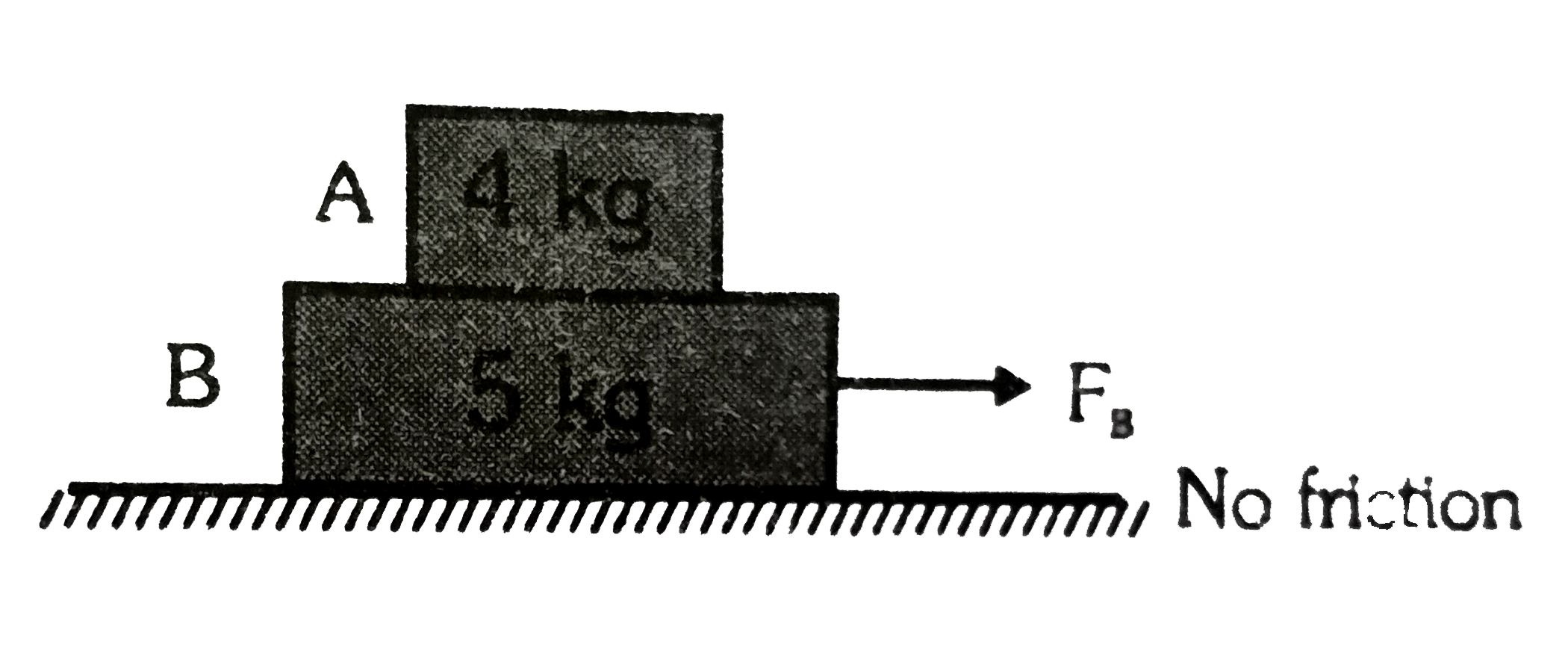
12N of force required to be applied on A to slip on B. Find the maximum horizontal force F to be applied on B so that A and B moves together.

A

25 N

B

26 N

C

30 N

D

27 N

Text Solution

Verified by Experts

The correct Answer is:

D
Promotional Banner

Similar Questions

Explore conceptually related problems

A block the of mass 4kg is placed on another block of mass 5kg and the block B rests on a smooth horizontal table for sliding the block A on B a horizontal force 12N is required to be applied force on it How much maximum horizontal force can be applied on 'B' s that both A and B move together? Also find out the accleration proudced by this force .

A 4 kg block A is placed on the top of 8 kg block B which rests on a smooth table. A just slips on B when a force of 12 N is applied on A. Then the maximum horizontal force F applied on B to make both A and B move together, is

Two blocks A and B are placed one over the other on a smooth horizontal surface. The maximum horizontal force that can be applied on the lower block A, so that A and B move without separation is 49N. The coefficient of friction between A and B is (take g = 9.8ms^(-2) )

Consider the situation shown in the figure . The coefficient of friction between the blocks is mu . Find the minimum and the maximum force F that can be applied so that two blocks move together.

Find the minimum value of force (in N) man should apply so that block can move

In the arrangement shown in figure, m_A = m_B = 2kg. String is massless and pulley is frictionless. Block B is resting on a smooth horizontal surface, while friction coefficient beteen block A and B is mu=0.5 . the Maximum horizontal force F that can be applied so that block A does not slip over block B is.

The coefficient of static friction between the two blocks shown in figure is mu and the table is smooth. What maximum horizontal forced F can be applied to he block of mass M so that the block move together?

Two block A and B of masses 5 kg. and 3 kg. respectively rest on smooth horizontal surface with B over A. The coefficient of friction between A and B. 0.5 the maximum horizontal force that can be applied to A so that there will be motion of A and B without separation is :-
