Home
Class 12
PHYSICS
A 10 kg mass moves 3,0 m against a retar...

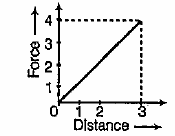
A 10 kg mass moves 3,0 m against a retarding force shown in the figure. If the force is zero at the beginning, how much kinetic energy is changed ?

A

6 J

B

`-6 J`

C

12 J

D

`-12J`

Text Solution

Verified by Experts

The correct Answer is:

B
Promotional Banner

Similar Questions

Explore conceptually related problems

A force shown in the F-x graph is applied to a 2kg block horizontal as shown in figure. The change in kinetic energy is

A 10 kg mass moves x-axis. Its acceleration as function of its position is shown in the figure. What is the total work done on the mass by the force as the mass moves from x = 0 to x = 8 cm ?

An object of mass 50 kg is moving in a horizontal circle of radius 8 m . If the centripetal force is 40 N, then the kinetic energy of an object will be

A particle is acted upon by a force F which varies with position x is shown in figure .If the particle at x = 0 kinetic energy of 25J then the kinetic energy of the particle at x = 16 m is

The only force acting on a 2.0-kg body as it moves along the x-axis varies as shown in figure. The velocity of the body at x=0 is 4.0ms^-1 . a. What is the kinetic energy of the body at x=3.0m ? b. At what value of x will the body have a kinetic energy of 8.0J ? c. What is the maximum kinetic energy attained by the body between x=0 and x=5.0m ?

A block of mass 10 kg is moving on a rough surface as shown in figure. The frictional force acting on block is :-

A 10-kg block moves in a straight line under the action of a force that varies with position as shown in figure. How much work does the force do as the block moves from origin to x=8m ?

A body of mass 2 kg initially at rest is moved by a horizontal force of 0.5 N on a smooth frictionless table. Obtain the work done by the force in 8 s and show that this equals the change in kinetic energy of the body.

A body of mass 2 kg, initially at rest, is moved through 3 m along the horizontal by a force of 10 N acting at an angle of 60^(@) with the horizontal. The kinetic energy gained by the body is
