Home
Class 12
PHYSICS
Two sources S1 and S2 emitting light of ...

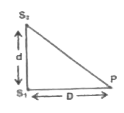
Two sources S1 and S2 emitting light of wave lengths 600 nm are placed a distance 1.0 x `10^(2)` cm apart..A detector can be moved on the line which is perpendicular to `SiS_(2)` . Find out the position of first.minimum detected.

A

1.5m

B

1.0m

C

1.07m

D

1.03m

Text Solution

Verified by Experts

The correct Answer is:

C
Promotional Banner

Similar Questions

Explore conceptually related problems

Two sources S_1 and S_2 emitting light of wave length 600 nm are placed a distance 1.0x10^-2 cm apart. A detector can be moved on the litre line S_1P which is perpendicular to S_1S_2 . a.What would be the minimum and maximum path differrence at the detector as it is moved alog the line S_1P ? b. Locate the position of the farthest minimum detect.

Two sources S_(1) and S_(2) emiting light of wavelenght 600 nm placed a distance 1.0 xx 10^(-2) cm apart. A detector can be moved on line S_(1) P which is perpendicular to S_(1) S_(2) (a) What would be the minimum and maximum path difference at the detector as it moves along line S_(1) P ? (b) Locate the psoition of the farthest minima detected .

Two sources of sound, S_1 and S_2 , emitting waves of equal wavelength 20.0 cm, are placed with a separation of 20.0 cm between them. A detector can be moved on a line parallel to S_1S_2 and at a distance of 20.0 cm from P it. Initially, the detector is equidistant from the two sources. Assuming that the waves emitted by the sources are in phase, find the minimum distance through wffich the detector should be shifted to detect a minimum of sound.

Two source of sound, S_(1) and S_(2) , emitting waves of equal wavelength 2 cm , are placed with a separation of 3 cm between them. A detector can be moved on a line parallel to S_(1) S_(2) and at a distance 24 cm from it. Initially, the detecor is equidistant from the two sources. Assuming that the waves emitted by the sources are in phase, find the minimum distance through which the detector should be shifted to detect a minimum of sound.

Two coherent point sources S_(1) and S_(2) vibrating in phase emit light of wavelength lambda . The separation between the sources is 2lambda . Consider a line passing through S_(1) and perpendicular to line S_(1) S_(2) . Find the position of farthest and nearest minima. .

A monochromatic point source (S_(1)) is at a distance d from a screen. Another identical source (S_(2)) is at a large distance from the screen. The two sources are on a line which is perpendicular to the screen. Sources are coherent. What is the shape of interference fringes on the screen? (b) Three identical coherent sources are placed on a straight line with two neighbouring ones separated by a distance "d = 0.06 mm" . The sources produce monochromatic light of wavelength lambda" = 550.4 nm" . A line AB is located at a distance D = 2.50 m from the sources and is perpendicular to line joining the three sources. Intensity of light at P with any one of the sources switched on is I_(o) . Find the intensity when all three sources are switched on. Distance of point P from O is "y = 1.72 cm (see figure)"

In the shown fig. S1 and S2 are two identical coher- ent sources of sound, separated by a distance d. A receiver moves along the line XY (which is parallel to line S1 S2) to detect the intensity of sound at various points on the line. Distance of line XY from line S1 S2 is D (gt gt d) . Point O is the foot of perpendicular bisector of the line S1 S2 on XY. Distance of first intensity maxima (on line XY) measured from O is y. Find percentage change in value of y if the temperature of air increases by 1%.

A source of sound emitting waves at 360 H_(Z) is placed in front of a vertical wall, at a distance 2 m from it. A detector is also placed in front of the wall at the same distance from it. Find the minimum distance between the source and the detestor for which the detector detects a maximum of sound. Take speed of sound in air = 360 m//s . Assume that there is not phase change in reflected wave.
