Home
Class 12
PHYSICS
Position-time graph for motion with zero...

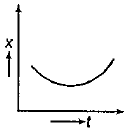
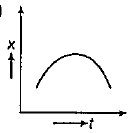
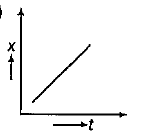
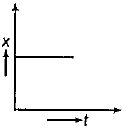
Position-time graph for motion with zero acceleration is

A

B

C

D

Text Solution

Verified by Experts

Promotional Banner

Similar Questions

Explore conceptually related problems

Position - time graph for motion with negative acceleration is

Assertion : The displacement-time graph of a body moving with uniform acceleration is a straight line. Reason : The displacement is proportional to time for uniformly accelerated motion.

How is the position-time graph of uniformly accelerated motion id one dimension helpful in studying the motion of the object ?

Draw position-time graphs for two objects having zero relative velocity.

STATEMENT - 1 : The slope on a position-time graph is representative of the acceleration of the object. STATEMENT - 2 : A straight, diagonal line on a position-time graph is representative of an onject with a constant velocity. STATEMENT - 3 : I an object is at rest, then the position-time graph must be a horizontal line located on the time-axis.

For given velocity time graphs in which case the acceleration is uniform and positive -

Draw the position-tie graph for uniformly accelerated motion. What does its slope give ?

Draw the position-time graph of a moving object, moving with zero acceleration.

Graphs are very useful to represent a physical situation. Various quantities can be easily represented on graphs and other quantites can be determined from the graph. For example the slope of velocity-time graph represents instantaneous acceleration. For a motion with constant acceleration slope of velocity-time graph is constant. If acceleration is changing with time, slope with change and thus velocity-time graph will be a non-linear curve. Further the area of velocity-time graph gives displacement. For the above situation let t_(1) be the time of accelerated motion and t_(2) be the time or retarded motion, then the correct relation is

Graphs are very useful to represent a physical situation. Various quantities can be easily represented on graphs and other quantites can be determined from the graph. For example the slope of velocity-time graph represents instantaneous acceleration. For a motion with constant acceleration slope of velocity-time graph is constant. If acceleration is changing with time, slope with change and thus velocity-time graph will be a non-linear curve. Further the area of velocity-time graph gives displacement. For the given velocity-time graph the possibly correct acceleration-time relationship is
