Home
Class 12
CHEMISTRY
In a solid having rock salt structure, i...

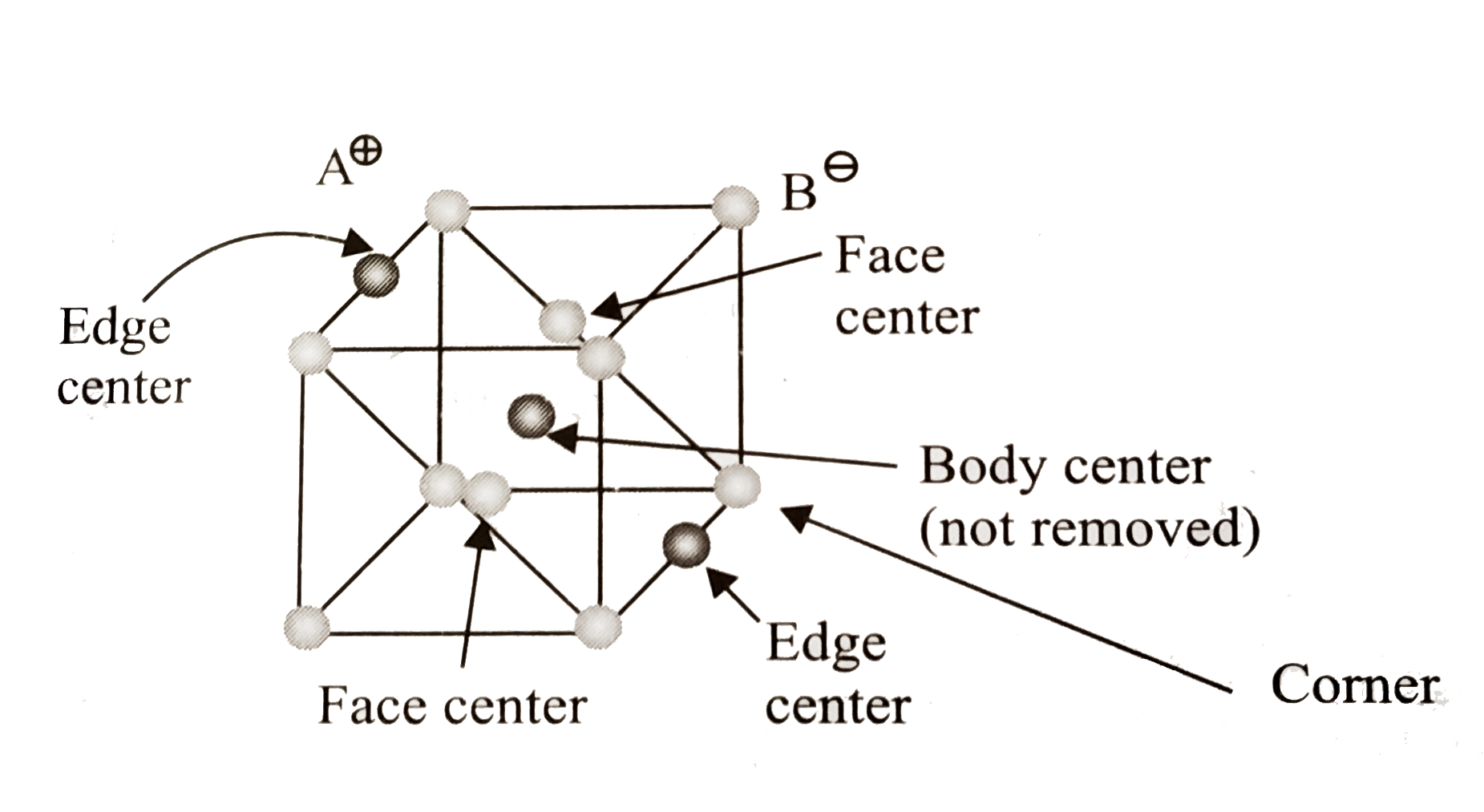
In a solid having rock salt structure, if all the atoms touching one body diagonal plane are removed (except at body centre), then the formula of the left unit cell is

A

`A_(3.5)B_(2.5)`

B

`A_(7)B_(3)`

C

`A_(5)B_(3)`

D

`A_(3)B_(5)`

Text Solution

Verified by Experts

The correct Answer is:
A

a.
`NaCl` (rock salt)-type structure is `fcc` type.
`( :. Z_(eff) = 4) [Z_(eff)(Na^(o+)) = 4, Z_(eff)(Cl^(Θ)) = 4]`
In `NaCl` structure anion `(Cl^(Θ))` (here `B^(Θ)`) are present at corners and face centre while cations `(Na^(o+))` (here `A^(o+))` are present in all `OV_(s)` (present at body centre and edge centre).
`:.` Number of `B^(Θ)` ions removed
`= 4 xx (1)/(8)` (corner share) `+ 2 xx (1)/(2)` (face centre share)
`= (1)/(2) + 1 = 3//2`
Number of `A^(o+)` ions removed `= 2 xx (1)/(4)` (edge centre share)
`= (1)/(2)`
`:.` Number of `B^(Θ)` ions left `= 4 - (3)/(2) = (5)/(2) = 2.5`
Number of `A^(o+)` ions left `= 4 - (1)/(2) = (7)/(2) = 3.5`
Thus, formula is: `A_(3.5)B_(2.5)`
Promotional Banner

Similar Questions

Explore conceptually related problems

If the ions are removed from a single body diagonal in above case after doping, then the molecular formula of the unit cell would be

A crystal is made up of particals X , Y , and Z . X froms fcc packing. Y occupies all octahedral voids of X and Z occupies all tetrahedral voids of X . If all the particles along one body diagonal are removed. Then the fromula of the crystal would be

A compound made of particles A , B , and C forms ccp lattice. In the lattice, ions A occupy the lattice points and ions B and C occuphy the alternate TV_(s) . If all the ions along one of the body diagonals are removed, then formula of the compound is

If atoms are removed from half of the edge-centred OV_(s) in RbBr , then the molecular formula of unit cell is

A compound is formed by elements A and B . This crystallises in the cubic structure where the A atoms are the corners of the cube and B atoms are at the body centres . The simplest formula of the compound is

A solid has a structure in which X atoms are located at cubic corners of unit cell, O atom are at the edge centres and Y atoms at cube centre. Then the formula of compound is X_(a)Y_(b)O_(c) If two atoms of O missing from any of two edge centres per unit cell, then the molecular formula is X_(a)Y_(b)O_(z) . Then, find the value of (x + y + z) - (a + b+ c) .

A compound formed by the element A and B crystallizes in the cubic structure, where A is at the corners of the cube and B is at body centre. What is the formula of the compound? If edge length is 5Å , calculate the density of the solid. (Atomic weights of A and B are 60 and 90 respectively).

In a solid 'AB' having NaCl structure, 'A' atoms occupy the corners of the cubic unit cell. If all the face-centred atoms along one of the axes are removed,then the resultant stiochiometry of the solid is

In a unit cell, atoms (A) are present at all corner lattices, (B) are present at alternate faces and all edge centres. Atoms (C) are present at face centres left from (B) and one at each body diagonal at disntance of 1//4th of body diagonal from corner. A tetrad axis is passed from the given unit cell and all the atoms touching the axis are removed. The possible formula of the compound left is

A crystalline solid has A^- ions at the corners and face centres where as B^+ ions are at the body centre and edge centres of the unit cell. The simplest formula of the compound will be

