Home
Class 12
CHEMISTRY
If all the atoms touching one face plane...

If all the atoms touching one face plane are removed in solid `A^(o+)B^(Θ)` having rock salt type structure, then the formula of the compound left and the defect brought by this removal, respectively, is
a. `AB`, Frenkel defect
b. `A_(2)B`, Frenkel defect
c. `AB`, Schottky defect
d. `A_(2)B`, Schottky defect

Text Solution

Verified by Experts
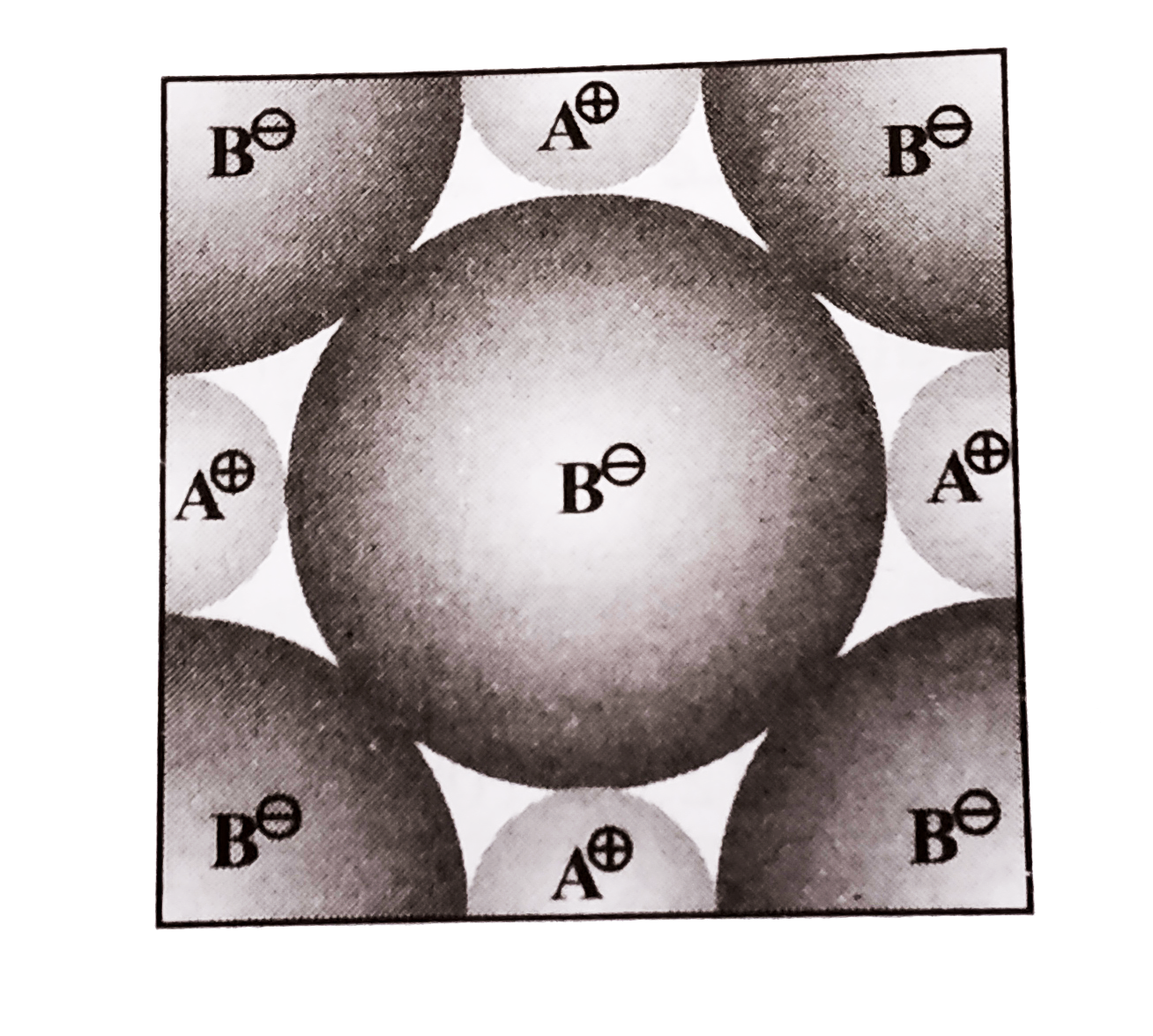
c. (i) Since `A^(o+)B^(Θ)` has `NaCl`-type `(fc c)` structure.
So `B^(Θ)` are in `(fc c)` arramgement.

Number if `B^(Θ)` ions `= 4`
(Corner `+` face centre `= 1 + 3 = 4)`
Number if `A^(o+)` ions `= 4`
[ in `OV` formed at body centre `+` edge centre `= 1 + 3 = 4]`

Number if `B^(Θ)` ions removed
`= 4` corner `xx (1)/(8)` per corner share
`+ 1` face centre `xx (1)/(2)` per face centre share
`= (4)/(8) + (1)/(2) = 1`

Number if `B^(Θ)` left `= 4 - 1 = 3`

Number if `A^(o+)` ions removed
`= 4` edge centre `xx (1)/(4)` per edge centre share `= (4)/(4) = 1`
Number if `A^(o+)` ions left `= 4 - 1 = 3`
Thus, formula `= A_(3)B_(3) = 3AB.`
ii. As Atoms (or ions) are completely removed.
Hence, the defect in the crystal is Schottky type.
Promotional Banner

Similar Questions

Explore conceptually related problems

In a solid having rock salt structure, if all the atoms touching one body diagonal plane are removed (except at body centre), then the formula of the left unit cell is

Calcium crystallizesin fcc unit cell with 0.556 nm . Calculate the density if a. It contains 0.2% Frenkel defects b. It contains 0.1% Schottky defects

(a) Calculate number of particles in Face Centred Cubic (FCC) structure. (b) Write any two differences between Frenkel and Schottky defects.

(a) Calculate the number of particles in Face Centred Cubic (FCC) lattice. (b) What is Frenkel defect? What is its effect on the density of a solid?

In a bundle of 50 shirts, 44 are good, 4 have minor defects, and 2 have major defects. What is the probability that (a) a trader buys only good shirts? (b) a trader rejects only a shirt with major defects?

The addition of CaCl_(2) crystal to KCl crystal a. Lowers the density of the KCl crystal b. Raises the density of the KCl crystal c. Does not affect the density of the KCl crystal d. Increases the Frenkel defects of the KCl crystal

A compound formed by elements X and Y has a cubic structure in which X atoms are at the face centres. Y atoms are present at the body center and also at the alternate edge center of the cube. a. Calculate: (i) Z_(eff') (ii) total number of atoms in a cube, and (iii) formula of the compound. b. If all the atoms are removed from a single axis passing through the centre of the cube, calculate (i) Z_(eff') (ii) total number of atoms in a cube, and (iii) formula of the compound.

The structural formula of ten compounds, (I) through (X) are drawn below, you may select any one of these structure. Answer the following question about that compound. A. How many chiral centre are present in this compound ? (a) 0 (b) 1 (c) 2 (d) 3 (e) 4 (f) 5 B. Is this compound chiral or achiral ? C. What symmetry element are present in this compound ? (a) None (b) Plane of symmetry (c) Center of symmetry

If a solid A^(o+)B^(ɵ) having ZnS Structure is heated so that the ions along two of the axis passing throgh the face centre particles are lost and bivalent ion (Z) enters herre to maintain the electrical neutrality, so that the new formula unit becomes A_(x)B_(y)C_(c) , report the value of x + y + c .

The electrons in the atoms of four elements A, B, C, and D are distributed in three shells having 1,3,5, and 7 electrons in their outermost shell respectively. State one period in which these elements can be placed in the Modern Periodic Table. Write the electronic configuration of the atoms A and D and molecular formula of the compound when A and D combine.

