Home
Class 12
CHEMISTRY
In fcc unit cell, atoms are numbered as ...

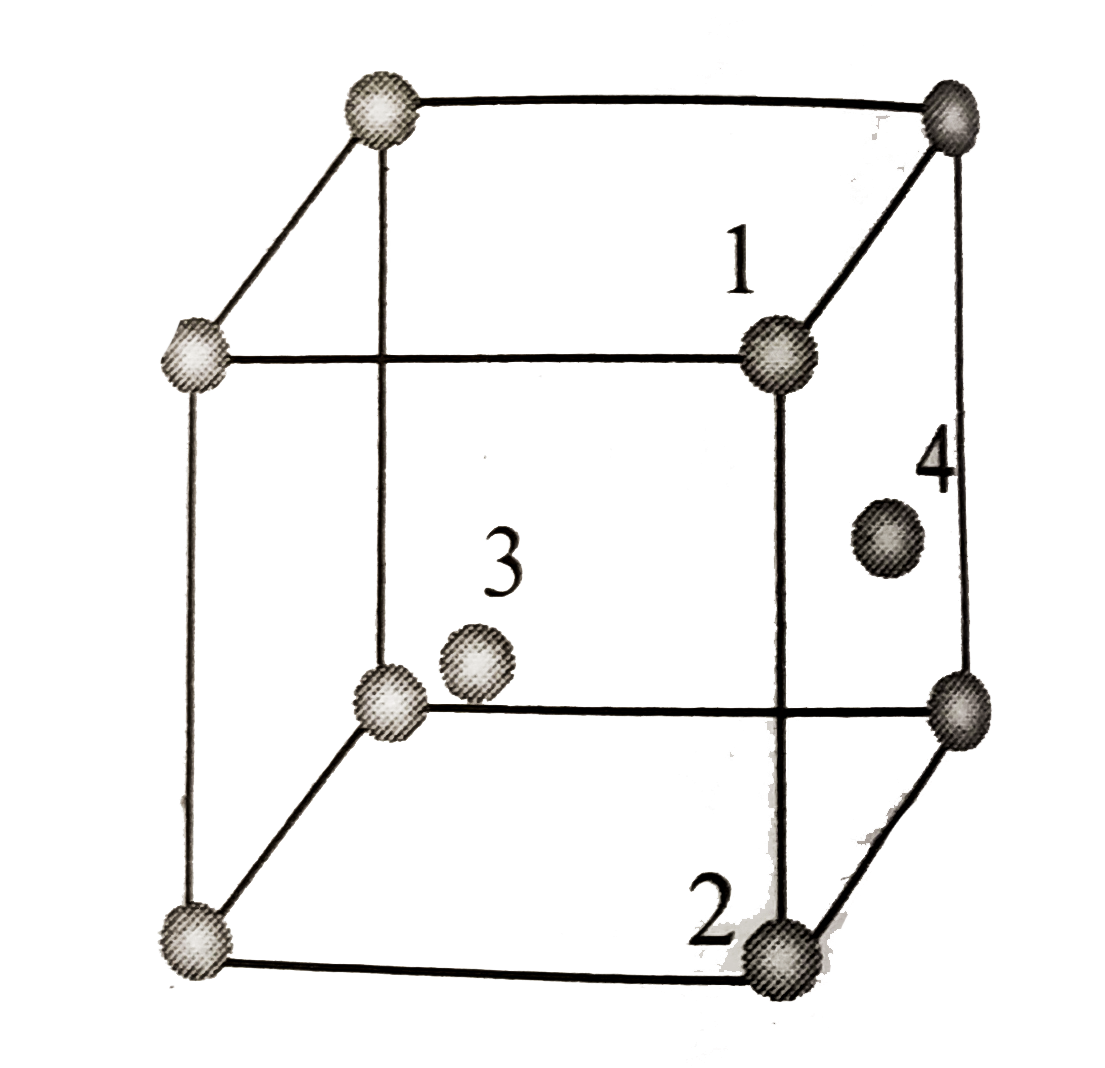
In fcc unit cell, atoms are numbered as shown below.
The atoms not touching each other are (Atom numbered `3` is face centre of front face)

A

`3` and `4`

B

`1` and `3`

C

`1` and `2`

D

`2` and `4`

Text Solution

Verified by Experts

The correct Answer is:

C

In fcc structure, corner atoms do not touch each other (atom `1` and `2`), but every face centre aton touches corners. Moreover, every face center atom touches every other face centre atom in an fcc unit cell.
i. Atoms `3` and `4` are `4` are touching each other where centre-to-centre distance `= (a)/(sqrt(2))`
ii. Atoms `1` and `2` are not touching each other.
iii. Atoms `2` and `4` are touching each other where centre-to-centre distance `= (a)/(sqrt(2))`
Promotional Banner

Similar Questions

Explore conceptually related problems

In bcc lattice, the atoms at the corners of the unit cell are in contact with each other.

The number of atoms in a face centred cubic unit cell is:

What is the contribution of the atom present at edge centre of the unit cell ?

Calculate number of particles in face centred cube unit cell (FCC).

Silver crystallises with face-centred cubic unit cells. Each side of the unit cell has a length of 409 pm. Calculate the radius of silver atom. (Assume the atoms just touch each other on the diagonal across the face of the unit cell. That is each face atom is touching the four corner atoms.)

In a unit cell, atoms (A) are present at all corner lattices, (B) are present at alternate faces and all edge centres. Atoms (C) are present at face centres left from (B) and one at each body diagonal at disntance of 1//4th of body diagonal from corner. A tetrad axis is passed from the given unit cell and all the atoms touching the axis are removed. The possible formula of the compound left is

In a unit cell, atoms (A) are present at all corner lattices, (B) are present at alternate faces and all edge centres. Atoms (C) are present at face centres left from (B) and one at each body diagonal at disntance of 1//4th of body diagonal from corner. Formula of given solid is

The number of atoms touching a particular atom in a crystal is called its ……….

Consider the bcc unit cells of the solids. 1 and 2 with the position of atoms as shown below. The radius of atom B is twice that of atom A. The unit cell edge length is 50% more in solid 2 than in 1. What is the approximate packing efficiency is solid 2?

If number of electron in an atom is 8 and number of proton is also 8, then (i) what is the atomic number of the atom and (ii) what is the charge on the atom ?
