Home
Class 12
CHEMISTRY
FeCl(3) on reaction with K(4)[Fe(CN)(6)]...

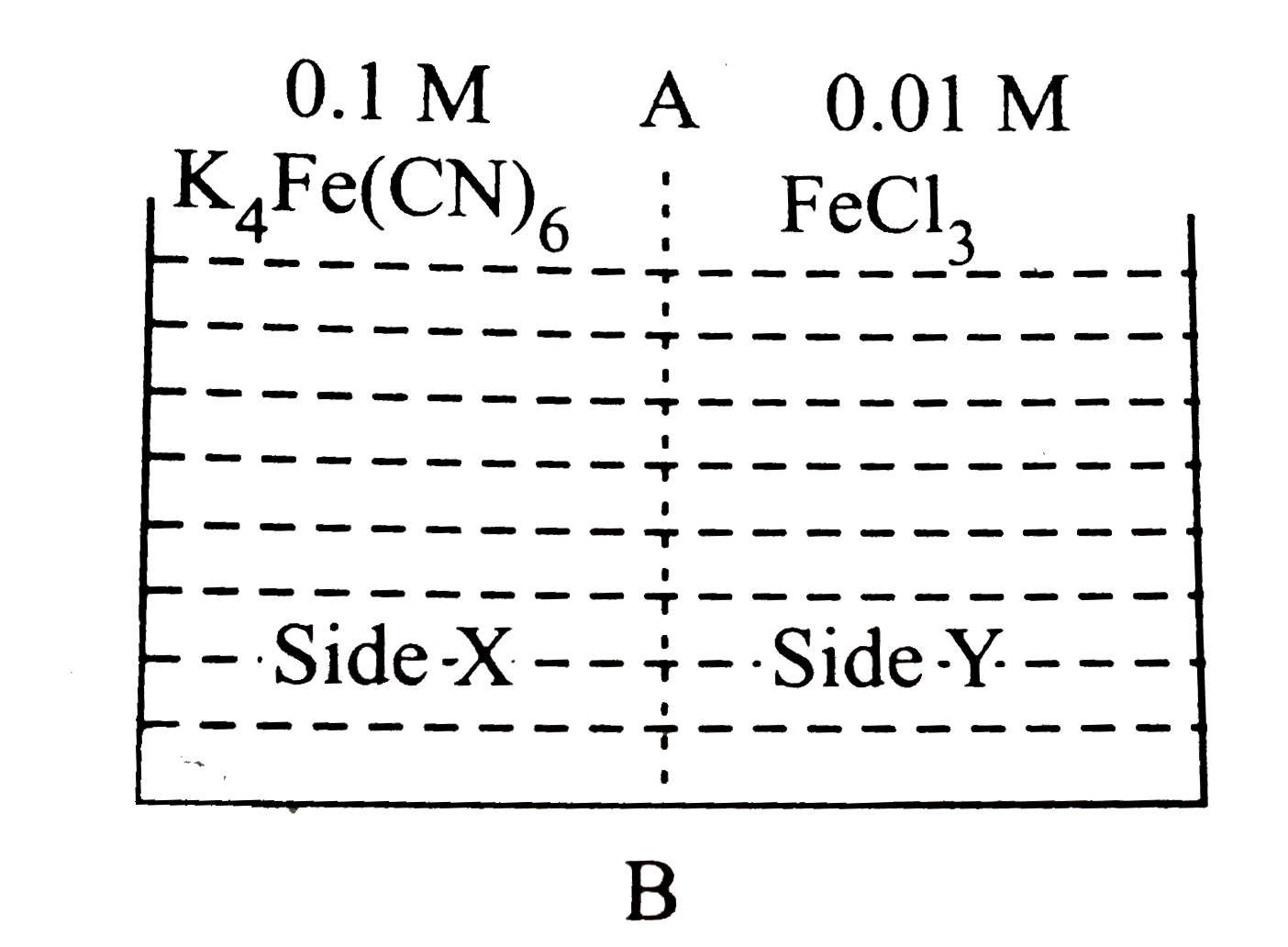
`FeCl_(3)` on reaction with `K_(4)[Fe(CN)_(6)]` in aqueous solution gives blue colour. These are separated by a semi-permeable membrane `AB` as shown. Due to osmosis, there is

A

Blue colour formation in side `X`.

B

Blue colour formation in side `Y`.

C

Blue colour formation in both of side `X` and `Y`.

D

No blue colour formation.

Text Solution

Verified by Experts

The correct Answer is:

D

Osmosis of water and not of ion takes place.
Promotional Banner

Similar Questions

Explore conceptually related problems

With K_4[Fe(CN)_6],Cu^(2+) ions give :

Aqueous solution of an acetate salt, when heated with FeCl_3 solution gives a blood red solution due to the formation of :

A 250 mL water solution containing 8.19 g of sodium chloride at 300 K is separated from pure water by means of a semi-permeable membrane. The pressure that must be applied above this solution in order to just prevent osmosis is "( R=0.0821 L atm mol^(-1) K^(-1) )" a.13.80 atm ,b.27.58 atm ,c.23.34 atm ,d.9.80 atm

CNS^(ө) ions give red colour with Fe^(3+) ions in aqueous solution as: Fe^(3+)(aq) + 3CNS^(ө)(aq) rarr Feunderset("red")((CNS))_(3)(aq) If 0.1 M KCNS solution is separated from 0.1 M FeCl_(3) solution by means of a semi-permeable membrane, red colour will appear on: a. FeCl_(3) soluion , b. KCNS solution side , c. Both sides , d. Neither side

A certain salt X gives the following results (i) Its aqueous solution shows alkaline to litmus paper (ii) It swells up to a hot glassy material Y on strong heating (iii) When conc. H_(2)SO_(4) is added to a solution of X white crystal of an acid Z separates out. Write equation for all the above reactions and identify X,Y and Z.

[Fe(CN)_6]^(4-) and Fe(H_2 O)_6]^(2+) are different colours in dilute solutions . Why ?

When hydrochloric acid is added to cobalt nitrate solution at room temperature, the following reaction takes place and the reaction mixture becomes blue. On cooling the mixture it becomes pink. On the basis of this information mark the correct answer. underset(("pink"))([Co(H_(2)O)_(6)]^(3+)(aq))+4Cl^(-)(aq)hArr underset(("blue"))([CoCl_(4)]^(2-))(aq)+6H_(3)O(l)

(a) Explain why electrolysis of aqueous solution of NaCl gives H_2 at cathode and Cl_2 at anode. Write overall reaction. (b) The resistancee of a conductivity cell containing 0.000M KCl solution at 298K is 1500 Omega . Calculate the cell constant if conductivity of 0.001M KCl solution at 298K is 0.146 times 10^-3 S cm^-1 .
