Home
Class 12
CHEMISTRY
A solution of Fe^(2+) is titrated potent...

A solution of `Fe^(2+)` is titrated potentiaometrically using `Ce^(4+)` solution . Calculate the `EMF` of the redox electrode thus formed when
`a. 50%` of `Fe^(2+)` is titrated { Given `:E^(0) = -0.77V}

Text Solution

Verified by Experts
`a.` During titration, the redox electrode is `Pt|Fe^(2+),Fe^(3+)` electrode
`E=E^(c-)._(cell)-(0.059)/(n)log.([Fe^(3+)])/([Fe^(2+)])`
`Fe^(3+) +e^(-) rarr e^(2+)`
At `50%` titration, `[Fe^(3+)]=[Fe^(2+)]`
`:. E=E^(c-)=-0.77V`
`b.` At `90%` titration, `([Fe^(3+)])/([Fe^(2+)])=(90)/(10)`
`{:(,Fe^(2+),rarr,Fe^(3+),+e^(-)),(Initial,90,,10,),(Fi nal,10,,90,):}`
`:. E=-0.77-0.059log 9 =-0.826 V`
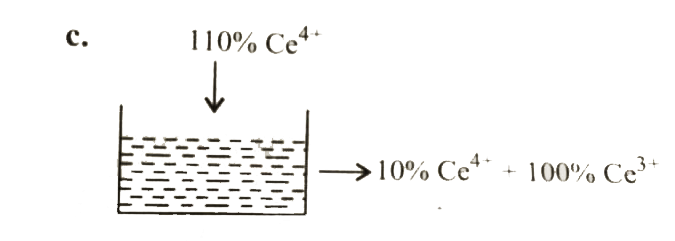
`c.`
At `100%` titration, the electrode becomes,
`Pt|Ce^(3+),Ce^(4+)` electrode,where`([Ce^(4+)])/([Ce^(3+)])=(10)/(100)`
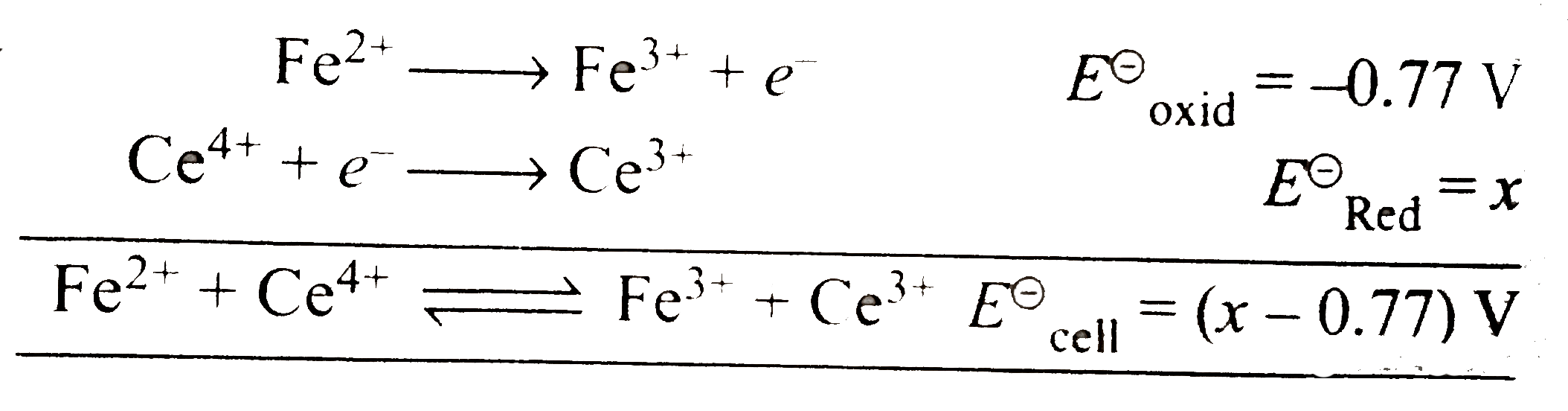
Cell reaction `:`

At equilibrium, `E_(cell)=0`
`E=E^(c-)._(cell)-(0.059)/(1) log K `
`E^(c-)._(cell)=(0.059)/(1) log 10^(14)`
`=0.826`
`:. x-0.77=0.822impliesx=1.596`
`:. E^(c-)._(Ce^(4+)//Ce^(3+))=1.596V`
`:.E^(c-)._(Ce^(3+)//Ce^(4+))=-1.596V`
So at `110%` titration,
`E_(Ce^(3+)//Ce^(4+))=E^(c-)._(Ce^(3+)//Ce^(4+))-0.059log .([Ce^(4+)])/([Ce^(3+)])`
`=-1.596-0.0596 log ((10)/(100))`
`=-1.596+0.059=-1.537`
Promotional Banner

Similar Questions

Explore conceptually related problems

Name the indicator used in the titration of Fe^(2+) against MnO_4^- in an acid medium.

The emf of the half cell Cu_((aq))^(2+)//Cu_((s)) containing "0.01 M Cu"^(2+) solution is +0.301 V . Calculate the standard emf of the half cell.

A decimolar solution of potassium ferrocyanlde K_(4) [Fe(CN)_(6)] is 50% dissociated at 3001K. Calculate the value of Van't Hoff factor for postuslum ferrocyanide.

A zinc electrode is placed in 0.1M solution of ZnSO_(4) at 25^(@)C . Assuming salt is dissociated to the extent of 20% at this dilution. The potential of this electrode at this temperature is : (E_(Zn^(2+)|Zn)^(@)=-0.76V) a. 0.79V" ".b. -0.79V" "c. -0.81V." "d. 0.81V

Calculate EMF of the cell represents below Zn//Zn^(2+)(C=0.1M)||Cu^(2+)(C=1M)//Cu" at "25^(@)C Given E_(Cu)^(0)=0.34E_(Zn)^(0)=0.76v

The quinhydrone electrode (Q,H^(o+)|H^(2)Q) is used in conjunction with a saturated calomel electrode, as represented below : EMF_(cell)=0.264V at 30^(@)C . Calculate the pH of unknown solution at this temperature. Given :E_(calomel)=0.24V and E^(c-)._(2H^(o+),Q|H_(2)Q)=0.7V

What is the potential of a half-cell consisting of zinc electrode in "0.01 M ZnSO_(4) solution 25^(@)C. E^(@) = 0.763 V.

20g of sample containing Ba(OH)_(2) is dissolved in 10 ml of 0.5 M HCl solution. The excess of HCl was then titrated against 0.2 M NaOH. The volume of NaOH used in the titration was 10 ml. Calculate the percentage of Ba(OH)_(2) in the sample. (Mol. wt. of Ba(OH_(2))=171)

The emf of a galvanic cell constituded with the electrodes Zn^(2+)//Zn (-0.76V) and Fe^(2+)//Fe (-0.41V) is