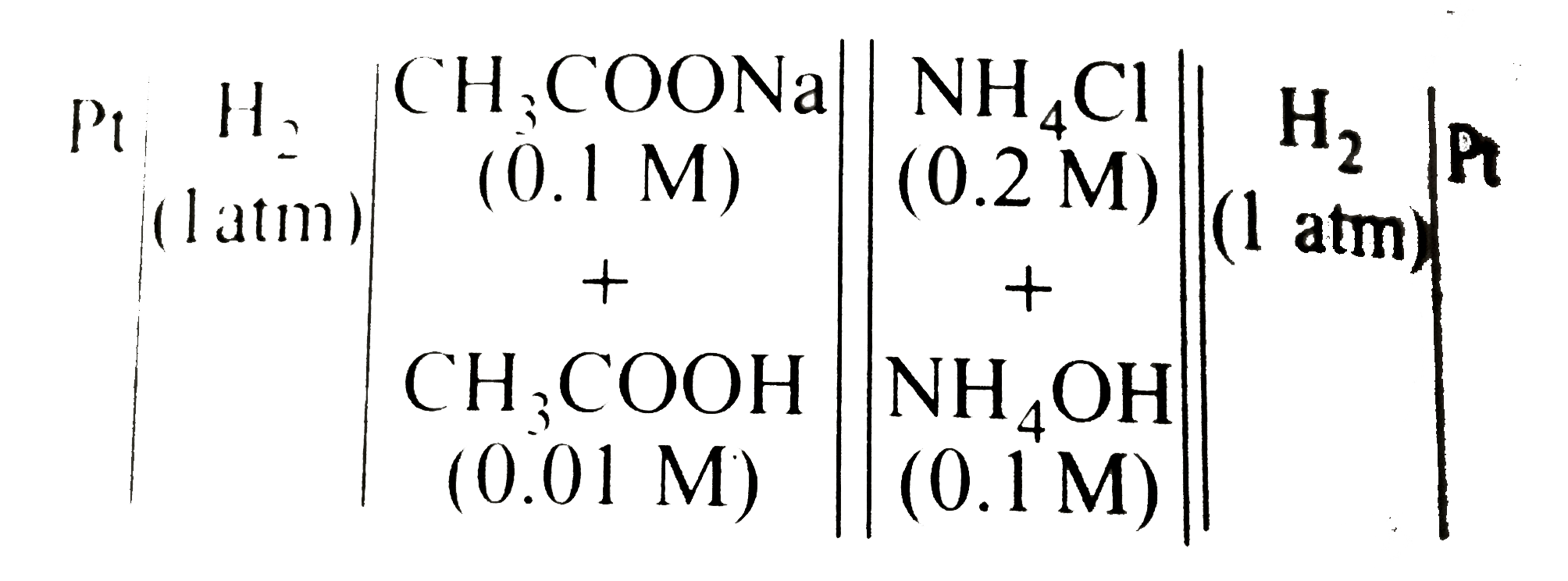
A
B
C
D
Text Solution
Verified by Experts
The correct Answer is:



Similar Questions
Explore conceptually related problems
Recommended Questions
- The potential of the cell at 25^(@)C is Given pK(a) of CH(3)COOH...
Text Solution
|
- Calculate the pH of a solution of given mixture. a. (2g CH(3)COOH +3g ...
Text Solution
|
- To 1.0L solution containing 0.1mol each of NH(3) and NH(4)C1,0.05mol N...
Text Solution
|
- Given the following cell at 25^(@)C What will be the potential of the ...
Text Solution
|
- The potential the cell at 25^(@)C is Given pK(b) of NH(4)OH=4.74
Text Solution
|
- The potential of the cell at 25^(@)C is Given pK(a) of CH(3)COOH and p...
Text Solution
|
- Calculate the pH of the following mixture 50mL of 0.05M CH(3)COOH+50...
Text Solution
|
- pK(a) of CH(3)COOH is 4.74 . The pH of 0.01 M CH(3)COONa IS
Text Solution
|
- The pH of a solution obtained by mixing 100mL of 0.3M CH(3)COOH with 1...
Text Solution
|