Home
Class 11
BIOLOGY
Though redundantly described as a restin...

Though redundantly described as a resting phase, interphase does not really involve rest. Comment.

Text Solution

Verified by Experts
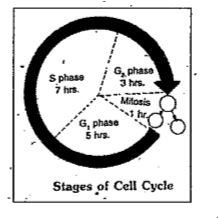
A . (1) In cell cycle, the stage at which the nucleus is not in a state of division is called interphase. It occurs between two successive divisions.
(2) During interphase, cell prepares for division by undergoing growth as well as DNA replication in an orderly manner, though considered as resting phase.

(3) On the basis of biochemical studies, interphase is subdivided into 3 stages: `G_(1)` phase , S phase and `G_(2)` phase.
`G_(1)` phase : Cell increases in size . RNA and propeins are synthesised in large quantity.
S phase , DNA replication occurs and its content increases to 4c from 2c.
`G_(2)` phase : Synthesis of proteins and RNA is continued. Various cell organelles are newly synthesised. The proteins and energy pools associated with the structure and movement of chromosomes are established.
Promotional Banner

Topper's Solved these Questions

  • MODEL PAPER 4

    VGS PUBLICATION-BRILLIANT|Exercise SECTION -C|3 Videos
  • MODEL PAPER 4

    VGS PUBLICATION-BRILLIANT|Exercise SECTION -C|3 Videos
  • MODEL PAPER 3

    VGS PUBLICATION-BRILLIANT|Exercise SECTION - C|3 Videos
  • MODEL PAPER 5

    VGS PUBLICATION-BRILLIANT|Exercise SECTION - B|6 Videos

Similar Questions

Explore conceptually related problems

In a circular motion of a particle the tangential acceleration of the particle is given by a_(1)= 2m//s^(2) . The radius of the circle described is 4 m. The particle is initially at rest. Time after which total acceleration of the particle makes 45^(@) with radial acceleration is :

(A): When a shell at rest explodes, the centre of mass fragments Continues at rest (R) : In explosion the linear momentum of the system does not remains conserved.

(A) : When an electron and proton are released from rest, though they are moving their center of mass remains at rest. (R ) : Proton is heavier than electron.

The body of sponges does not possess tissue level of organisation, though it is made up of thousands of cells. Comment on it.

