Evidences from comparative anatomy : When we compare the anatomy of different animals, we find some similarities among them . For example, the fore limbs of different vertebrates are similar in origin and internal structure . All these indicate that there is a relationship among the organisms . These relationships can be studied under
i) Homologous organs,
ii) Analogous organs,
iii) Vestigial organs,
iv) Atavistic organs and
v) Connecting links .
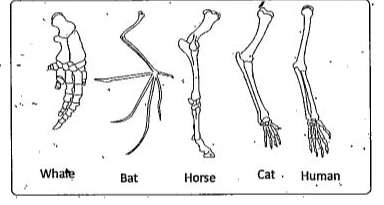
i) Homologous organs : The organs which have similar structure and origin but not necessarily the same function are called homologous organs . The evolutionary pattern that describes the occurrence of similarity in origin and internal structure is called homology . Such organs show adaptive radiation, hence .divergent evolution. . e.g., the appendages of vertebrates such as the flippers of whale, wings of bat, forelimbs of horse, paw of cat and hand of man have a ommon pattern in the arrangement of bones even through their external form and function may vary to suit their mode of life . It explains that all the vertebrates might have had a common ancestor .
Analogous organs : The organs which have dissimilar structure and origin but perform the same function are called the analogous organs . Analogous organs suggest .convergent evolution., e.g., wings of a butterfly and wings of a bird .
iii) Vestigial organs : The organs which were functional in the ancestors but non-functional and reduced in the descendants are called vestigial organs . Presence of vestigial organs is the most convincing evidence in favour of organic evolution and also supports the concept of disuse proposed by Lamarck, e.g., Hind Limbs in python, hind limbs and pelvic girdle in whale, wings of flightless birds, vermiform appendix, coccyx, plica semilunaris (vestigial nictitating membrance ), auricular muscles that move the pinna, hair on the body , mammary glands in males, etc, in human beings :
iv) Atavistic organs : Sudden appearance of some vestigial organs in a better developed condition as in the case of the tailed human body is called atavism . Such organs are called atavistic organs . They strongly support the concept of organic evolution .
v) Connecting links : The organisms which possess the characters of two different gropus between which they are transitional are called connecting links . They clearly explain the path of evolution, e.g. Peripatus between annelida and arthropoda, prototherians between reptilia and mammalia, etc.


