Home
Class 12
CHEMISTRY
Explain Tyndall effect and Brownian move...

Explain Tyndall effect and Brownian movement. 

Text Solution

Verified by Experts
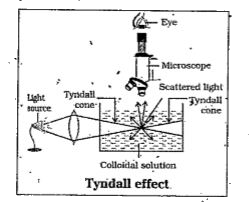
Tydall Effect : When a beam of light is passed through a colloidal solution the colloidal particles scatter the light in all directions. This scattering of light illuminates the path of beam in colloidal dispersion. This is known as tyndall effect. The bright cone of the light is called Tyndall cone.

Tyndall effect is observed only when the following two conditions are satisfied.
i) The diameter of the colloidal particle should not be much smaller than the wave length of the light used.
ii) The refractive indices of the dispersed phase and the dispersion medium should differ greatly in magnitude.
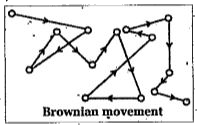
Brownian movement : The colloidal particles are in continuous zig-zag motion due to bombardment of the molecules of the dispersion medium on colloidal particles.
The motion of colloidal particle is independent of the nature of the colloid but depends on the size of the particles and viscosity of the solution.
Promotional Banner

Topper's Solved these Questions

  • MODEL PAPER 5

    VGS PUBLICATION-BRILLIANT|Exercise SECTION - C|8 Videos
  • MODEL PAPER 5

    VGS PUBLICATION-BRILLIANT|Exercise SECTION - C|8 Videos
  • MODEL PAPER 4

    VGS PUBLICATION-BRILLIANT|Exercise SECTION-C|11 Videos
  • MODEL PAPER 6

    VGS PUBLICATION-BRILLIANT|Exercise SECTION - C|6 Videos

Similar Questions

Explore conceptually related problems

What is Brownian movement.

What is Tyndall effect ?

Explain inductive effect

Explain resonanace effect

Tyndall effect cannot be shown by

Explain the phenomenon of Brownian movement giving reasons for the occurrence of this phenomenia.

Explain inert pair effect.

Tyndall effect observed only when

Where can we observe the protoplasmic movements called Brownian movements?