Home
Class 12
CHEMISTRY
Explain ionic bond with suitable example...

Explain ionic bond with suitable example.

Text Solution

Verified by Experts
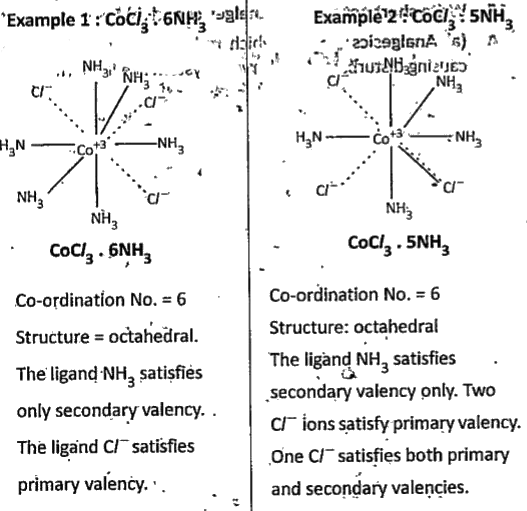
1) Every complex comp i contains a central atom (or) ion.
2) The central metal atom (or) ion exhibits two types of valencies. They are a) Primary valency b) Secondary valency.
a) The Primary valency: It is numerically equal to the oxidation number of the metal atom or ion. These valencies. are ionisable. These valencies are represented by dotted line (. . . . . . )These valencies are non- directional.
b) Secondary valency: The number of chemical groups bound to the central atom (or) ion is equal to secondary valency. This is also called co-ordination number. These ies are directional and non-ionisable. These are represented by thick line(________)
3) Some ligands may. satisfy both primary and secondary valencies. Such ligands do not onise.
4) The primary valency, is known, as outer, sphere while the secondary valency is known as inner sphere for.co-ordination sphere
Promotional Banner

Topper's Solved these Questions

  • MODEL PAPER

    VGS PUBLICATION-BRILLIANT|Exercise Section - C|8 Videos
  • MODEL PAPER

    VGS PUBLICATION-BRILLIANT|Exercise Section - C|8 Videos
  • HYDROGEN AND ITS COMPOUNDS

    VGS PUBLICATION-BRILLIANT|Exercise Long Answer Questions|20 Videos
  • MODEL PAPER 1

    VGS PUBLICATION-BRILLIANT|Exercise SECTION-C|9 Videos

Similar Questions

Explore conceptually related problems

Explain coagulation with suitable examples.

Explain the formation of Ionic Bond with a suitable example.

What is Stereoisomerism ? Explain the geometrical' isomerism in coordinationi compounds with suitable example.

Allotropy is a property shown by which class of substances:elements, compounds or mixtures? Explain allotropy with suitable examples.

Explain Polar Covalent bond with a suitable example.

Define an ecosystem. Explain it with a suitable example.

Explain the following with suitable examples : Ionic hydrides

Explain the following with suitable examples : Electron deficient hydrides

