Home
Class 12
CHEMISTRY
Give a detailed account of the Collision...

Give a detailed account of the Collision theory of reaction rates of biomolecular reaction.

Text Solution

Verified by Experts
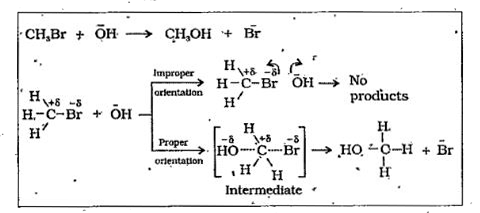
According to collision, theory, the reactant molecules are assumed to be hard spheres and reaction, occur only when molecules collide each other. The number of collisions per second per unit volume of the reaction mixture is known as collision frequency (Z). Activation energy also effects the rate of chemical reactions. For a bimolecular elementary reaction
`A + B to ` Products
Rate of reaction is
Rate ` = A_(AB)e ^(-E_(a)//RT)`
Where ` Z_(AB)` represents the collision frequecy of reactants. A and B and ` e^(-E_(a)//RT)` represents the fraction of molecules with energies equal to or greater than `E_(a)`
All collisions do not lead to the formation of products. The collisions in which the molecules having threshold energy and proper orientation leads to the formation of products: Such collisions are called effective collisions:
If the colliding molecules have improper orientation they bounce back and no reaction takes place.
To account for effective collisionis a new factor-.p. called probability or steric factor is introduced
Rate ` = PZ _(AB)e^(-E_(a)// RT)`

Thus, in collision theory activation energy and proper orientation of the molecules together determine the criteria for an effective collision and hence the rate of a chemical reaction.
Promotional Banner

Topper's Solved these Questions

  • MODEL PAPER 12

    VGS PUBLICATION-BRILLIANT|Exercise Section - B|12 Videos
  • MODEL PAPER 10

    VGS PUBLICATION-BRILLIANT|Exercise SECTION-C|10 Videos
  • MODEL PAPER 3

    VGS PUBLICATION-BRILLIANT|Exercise SECTION-C|10 Videos

Similar Questions

Explore conceptually related problems

Write the main points of collision theory of reaction rates .

Define reaction rate.

The rate of a chemical reaction

According to collision theory of reaction rates, the activation energy is

Give an account of the main types of reactions in organic chemistry?

Collision theory satisfactorily explains

