Home
Class 14
ENVIRONMENTAL STUDIES
The following word problem was given to ...

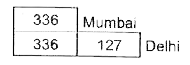
The following word problem was given to a child of Class IV Mumbai has 336 bus stops. Delhi has 127 more bus stops than Mumbai. How many bus stops are there in all, in Delhi? The child's response to the above problem is recorded as

Total bus stops in Delhi are 336 + 127 = 463
The teacher shall report about his performance as

A

The child can find the answer correctly but his expression is poor

B

The child is good at visualizing and analyzing, and his problem-solving ability is appreciable

C

The child has not adopted the right procedure. He needs to practice more

D

The child is not able to write all steps required properly

Text Solution

Verified by Experts

The correct Answer is:

B
Promotional Banner

Similar Questions

Explore conceptually related problems

Study the given information carefully and answer the questions that follow. The table given below shows the capacity of 5 buses (A, B, C, D, E) and the percentage of seats that were filled out of the total seating capacity of the buses. Some of the data is missing and is denoted as N/A A) The total number fo vacant seats in all the 5 nuses together were 40 B) The number of seats in buses D and E together were 65 20% of the passengers on bus D got down at Yarivali bus stop and 2 passengers boarded the bus from the same bus stop. The conductor started charging from Yarivali bus stop. The number of adults and children on he bus were in the ratio 2 : 1 . If the total collection of bus fare was Rs. 800, what was the bus fare for each child? Consider, there were no other stoppages till the final stop, The bus ticket was free till Yarivali bus stop and children's tricket price was half of that of adult.

Read following passage and answer item that follow. An earthquake comes like a thief in the night, without warning. It was necessary, therefore, to invent instruments that neither slumbered nor slept. Some devices were quite simple. One, for instance, consisted of rods of various lengths and thicknesses which would stand up on end like ninepins. When a shock came it shook the rigid table upon which these stood. If it were gentle, only the more unstable rods fell. If it were severe, they all fell. Thus the rods by falling and by the direction in which they fell, recorded for the slumbering scientist. But, instruments far more delicate than that were needed if any really serious advance was to be made. The ideal to be aimed at was to devise an instrument that could record with a pen on paper the movements, of the ground or of the table, as the quake passed by. But when table, penholder and paper are all moving how is it possible to write legibly ? The key to a solution of that problem lay in an everyday observation. Why does a person standing in a bus or train tend to fall when a sudden start is made ? It is because his feet move on, but his head stays still. The everyday observation referred to in the passage relates to :

In a given statement followed by three assumptions numbered I, II and III. An assumption is something supposed or taken for granted. You have to consider the statement and the following assumptions and decide which of the assumptions is implicit in the statement. Then decide which of the answers (1), (2), (3),(4) and (s) is the correct answer. Statement : "Our school provides all facilities like school bus service, computer training, sports facilities. it also gives opportunity to participate in various extra-curricular activities apart from studies," - An advertisement y a public school. Assumptions : I. Nowadays extra-curricular activities assume more importance than studies. II. many parents would like to send their children to the school as it provides all the facilities. III. Overall care of the child has become the need of the time as many women are working. 1) Only I is implicit 2) Only II is implicit 3) Only I and II are implicit 4) All I, II and III are implicit 5) None of these

Read the following passage and answer the questions given after it. A great water scarcity looms over India, by 2025 Indians will get just over half the water they get today. This grave problem has a simple solution. Catch the rain as it falls, and the water crisis will disappear. However, about 80 per cent of India’s rainfall buckets down during the three months of the monsoons. As yet, no government programmer has discovered how to store this water. ‘Dying Wisdom’, a seven-year countryside study by Delhi’s Centre for Science and Environment, reveals that ruins of amazing ancient technologies survive in every corner of India. Drip-irrigation systems of bamboo pipes in Meghalaya, ‘kunds’, underground tanks in Rajasthan, ‘pynes’, water channels built by tribals in Bihar, and thousands of open-water bodies down south are all superb examples of rain water harvesting systems. Even today, tanks called ‘eris’ in Tamil Nadu water one-third of the state’s irrigated area. Unfortunately, governmental planners mostly refuse to acknowledge the potential of these low-cost systems, concentrating on costly dams and canals Few cities have lost touch with their ecological traditions as fast–and with as damaging results–as Bangalore. Only 17 of its water bodies struggle to survive in a city where once 200 lakes, ponds and wetlands cooled the city and recharged its ground water. The threats continue unabated as the relentless march of urbanization shows no sign of stopping. Which of the following is not a low cost technology in water usage?

CTET MASTER-EVS CONTENT AND PEDAGOGY-MULTIPLE CHOICE QUESTIONS
  1. For the reaction R- Br to R- O - N =O the suitable reagent is

    Text Solution

    |

  2. A teacher distributed newspaper in Class V and asked the students to r...

    Text Solution

    |

  3. The following word problem was given to a child of Class IV Mumbai has...

    Text Solution

    |

  4. A student was asked to read the following numbers 306, 408, 4008, 4010...

    Text Solution

    |

  5. The parameter (s) of assessment for time' for Class IV shall be

    Text Solution

    |

  6. Tall shape of Mathematics' mentioned in NCF, 2005 refers to

    Text Solution

    |

  7. Consider the following 5+3 = ? The open-ended question corresponding t...

    Text Solution

    |

  8. Farhan went to school library and found that 100 books kept in story s...

    Text Solution

    |

  9. As per NCF 2005, teaching of numbers and operations on them, measureme...

    Text Solution

    |

  10. In Class III, a teacher asked the students to add 4562 and 728. A stud...

    Text Solution

    |

  11. Which of the following problems from the textbook of Class IV refers t...

    Text Solution

    |

  12. The following grid is drawn on a square paper This representation...

    Text Solution

    |

  13. Children at primary stage are able to classify the given shapes based ...

    Text Solution

    |

  14. Manipulative models, static pictures, written symbols, spoken and writ...

    Text Solution

    |

  15. After teaching the concept of division, a teacher created a 'Mathemati...

    Text Solution

    |

  16. Possible indicator pertaining to visual memory barrier hampering with ...

    Text Solution

    |

  17. A teacher in Class III distributed the following cards and asked the c...

    Text Solution

    |

  18. Geo-Board is an effective tool to teach

    Text Solution

    |

  19. Proficiency in mathematical language in classroom can be enhanced by p...

    Text Solution

    |

  20. Procedural fluency in Mathematics implies knowledge of rules, formulae...

    Text Solution

    |
