Home
Class 12
MATHS
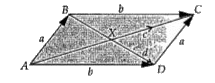
ABCD is a parallelogram whose adjacent s...

ABCD is a parallelogram whose adjacent sides are represented by the vectors `vec(a)` and `vec(b)`. Three of its vertices are A(1,2,3),B(2,0,5) and D(-1,4,1).

Area of ABCD = _______sq. units.

A

8

B

4

C

`2sqrt(2)`

D

16

Text Solution

Verified by Experts

The correct Answer is:

C
Promotional Banner

Similar Questions

Explore conceptually related problems

ABCD is a parallelogram whose adjacent sides are represented by he vectors vec(a) and vec(b) . Three of its vertices are A(1,2,3),B(2,0,5) and D(-1,4,1). The vector vec(a)= _______.

ABCD is a parallelogram whose adjacent sides are represented by he vectors vec(a) and vec(b) . Three of its vertices are A(1,2,3),B(2,0,5) and D(-1,4,1). The diagonal vec(d)= ___________.

The area of a parallelogram whose adjacent sides are determined by the vectors vec a=i+2j+3k and vec b=-3i-2j+k

If a parallelogram is formed with two sides represented by vector vec(a) and vec(b) , then vec(a)+vec(b) represents the

Let vec a=hat i+alphahat j+3hat k and vec b=3hat i-alphahat j+hat k .If the area of the parallelogram whose adjacent sides are represented by the vectors vec a and vec b is 8sqrt(3) square units,then vec a*vec b is equal to

Find the area of a parallelogram ABCD if three of its vertices are A(2,4),B(2+sqrt(3),5) and C(2,6)

Find the area of the parallelogram whose adjacent sides are determined by the vectors vec a=hat i-hat j+3hat k and vec b=2hat i-hat 7hat j+hat k

Find the area of the parallelogram whose adjacent sides are determined by the vectors vec a=hat i-hat j+3hat k and vec b=2hat i-7hat j+hat k
