Home
Class 12
CHEMISTRY
Consider gases confined by a liquid, as ...

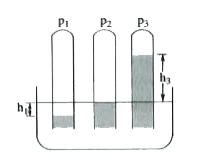
Consider gases confined by a liquid, as shown below.
Density of the liquid = `d."gmL"^(-1)`
`h_(1)` and `h_(3)` in mm and `p_(1), p_(2)` and `p_(3)` in mm Hg.

In terms of barometric pressure `(p_("atm"))P_(p)` is

A

`p_(1)`

B

`p_(2)`

C

`p_(3)`

D

`p_(1) + p_(2) + p_(3)`

Text Solution

Verified by Experts

Promotional Banner

Similar Questions

Explore conceptually related problems

Consider gases confined by a liquid, as shown below. Density of the liquid = d."gmL"^(-1) h_(1) and h_(3) in mm and p_(1), p_(2) and p_(3) in mm Hg. Select correct relation for pressure p_(3)

Assume gases confined by a liquid, as shown below. Density of the liquid = d."gmL"^(-1) h_(1) and h_(3) in mm and p_(1), p_(2) and p_(3) in mm Hg. Select correct relation for pressure p_(3)

If P_(atm) = 0 mm Hg and P_(alv) = -2 mm Hg, then

Water is flowing through a pipe as shown in figure. If P_(1), P_(2) and P_(3) are pressures and v_(1), v_(2) and v_(3) are velocities of water at the different sections as shown in figure, then

Assertion : In the given figure shown, p_(1)=p_(2) . Reason : Pressure at 1 is less than the atmospheric pressure.

Calculate the pressure inside a small air bubble of radus r situated at a depth h below the free surface of liquids of densities rho_(1) and rho_(2) and surface tennsions T_(1) and T_(2) . The thickness of the first and second liquids are h_(1) and h_(2) respectively. Take atmosphere pressure =P_(0) .

The pressure P_(1) at the top of a dam and P_(2) at a depth h from the top inside water (density rho ) are related as :

In the figure shown the velocity and pressure of the liquid at the cross section (2) are given by (If P_(0) is the atmospheric pressure).

A capillary tube is dipped in a liquid. Let pressure at point A,B and C be p_(A)p_(B) and p_(C) respectively, then 1) p A = p B = p C 2)p A = p B 3)p A = p C 4)p A = p C > p B

Let A, B and C be three mutually exclusive events such that P(A) = p_(1) , P(B) = p_(2) and P( C) = p_(3) . Then, Let p_(1) = 1/2(1-p), p_(2) = 1/3(1+2p) " and " p_(3) = 1/5(2+3p) , then p belongs to

