Home
Class 12
CHEMISTRY
For the dissociation of PCI(5) into PCI(...

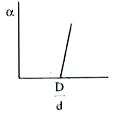
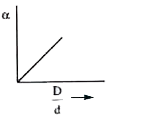
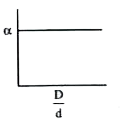
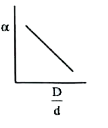
For the dissociation of `PCI_(5)` into `PCI_(3) and Cl_(2)` in gaseous phase reaction, If "d' is the observed vapour density and 'D' theoretical vapour density with `'alpha'` as degree of dissociation. Variation of `(D)/(d)` with `'alpha'` is given by which graph?

A

B

C

D

Text Solution

AI Generated Solution

The correct Answer is:

To solve the problem regarding the dissociation of \( PCl_5 \) into \( PCl_3 \) and \( Cl_2 \) in the gaseous phase, we will analyze the relationship between the observed vapor density \( d \), the theoretical vapor density \( D \), and the degree of dissociation \( \alpha \). ### Step-by-Step Solution: 1. **Write the Reaction:** The dissociation reaction can be written as: \[ PCl_5 (g) \rightleftharpoons PCl_3 (g) + Cl_2 (g) \] 2. **Determine the Moles of Gaseous Products:** From the reaction, we see that 1 mole of \( PCl_5 \) produces 2 moles of gaseous products (\( PCl_3 \) and \( Cl_2 \)). Therefore, if we consider 1 mole of \( PCl_5 \), the total number of moles after dissociation is: \[ n = 2 \quad (\text{where } n \text{ is the number of moles of gaseous products}) \] 3. **Define the Theoretical and Observed Vapor Densities:** - Theoretical vapor density \( D \) is calculated based on the initial moles before dissociation. - The observed vapor density \( d \) changes as \( PCl_5 \) dissociates. 4. **Relate Vapor Densities to Degree of Dissociation:** The degree of dissociation \( \alpha \) is defined as the fraction of the original substance that has dissociated. The relationship between the vapor densities can be expressed as: \[ D - d = (n - 1) \cdot d \cdot \alpha \] Substituting \( n = 2 \): \[ D - d = (2 - 1) \cdot d \cdot \alpha = d \cdot \alpha \] Rearranging gives: \[ D = d + d \cdot \alpha = d(1 + \alpha) \] 5. **Express \( \frac{D}{d} \) in terms of \( \alpha \):** Dividing both sides by \( d \): \[ \frac{D}{d} = 1 + \alpha \] 6. **Determine the Relationship:** This equation shows that \( \frac{D}{d} \) increases linearly with \( \alpha \). Specifically, when \( \alpha = 0 \), \( \frac{D}{d} = 1 \), and as \( \alpha \) approaches 1, \( \frac{D}{d} \) approaches 2. 7. **Graphical Representation:** - The graph of \( \frac{D}{d} \) (y-axis) versus \( \alpha \) (x-axis) will be a straight line starting from (0, 1) and going up to (1, 2). - The slope of the line is positive, indicating a direct relationship between \( \frac{D}{d} \) and \( \alpha \). ### Conclusion: The variation of \( \frac{D}{d} \) with \( \alpha \) is represented by a straight line graph with a positive slope, starting from \( \frac{D}{d} = 1 \) when \( \alpha = 0 \) and reaching \( \frac{D}{d} = 2 \) when \( \alpha = 1 \).
Promotional Banner

Similar Questions

Explore conceptually related problems

For the dissociation of PCl_(5) into PCl_(3) and Cl_(2) in gaseous phase reaction , if d is the observed vapour density and D the theoretical vapour density with 'alpha' as degree of dissociation ,variaton of D/d with 'alpha' is given by ?

For a very small extent of dissociation of PCl_(5) into PCl_(3) and Cl_(2) is a gaseous phase reaction then degree of dissociation , x :

Consider the following hypothetical equilibrium 2B(g)hArrB_(2)(g) If d is observed vapour density and D is theoretical vapour density, then degree of association (alpha) will be

In the dissociation of N_(2)O_(4) into NO_(2), (1+ alpha) values with the vapour densities ratio ((D)/(d)) is given by: [ alpha degree of dissociation, D-vapour density before dissociation, d-vapour density after dissociation]

For the reaction PCl_(5)hArrPCl_(3)+Cl_(2) , Supposing at constant temperature, if the volume is increased 16 times the initial volume, the degree of dissociation for this reaction will becomes:

During thermal dissociation, the observed vapour density of N_(2)O_(4)(g) is 26.0. The extent of dissociation of N_(2)O_(4) is:

The vapour density of PCl_(5) at 43K is is found to be 70.2 . Find the degree of dissociation of PCl_(5) at this temperature.

The vapour density of Pcl_(5) is 104.16 but when heated to 230^(@)C , its vapour density is reduced to 62 . The degree of dissociation of PCl_(5) at 230^(@)C is …………

The vapour density of Pcl_(5) is 104.16 but when heated to 230^(@)C , its vapour density is reduced to 62 . The degree of dissociation of PCl_(5) at 230^(@)C is …………

Vapour density of N_(2)O_(4) of x 60^(@) C is found to be 30.6 The degree of dissociation of N_(2) O_(4) is :
