Home
Class 12
CHEMISTRY
An ideal gas in a thermally insulated ve...

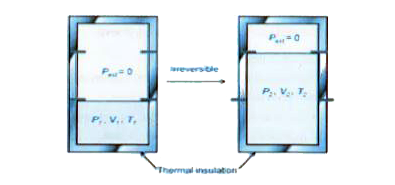
An ideal gas in a thermally insulated vessel at internal pressure = `P_(1)`, volume =`V_(1)` and absolute temperature =`T_(1)` expands irreversibly against zero external pressure, as shown in the diagram. The final internal pressure, volume and absolute temperature of the gas are `P_(2), V_(2) and T_(2)`, respectively. For this expansion.

A

q=0

B

`T_(2)= T_(1)`

C

`P_(2)V_(2)= P_(1)V_(1)`

D

`P_(2)V_(2)^(gamma) = P_(1)V_(1)^(gamma)`

Text Solution

Verified by Experts

The correct Answer is:

A, B, C
Promotional Banner

Similar Questions

Explore conceptually related problems

A gas enclosed in a vessel has pressure P, volume V and absolute temperature T, write the formula for number of molecule N of the gas.

An ideal gas has pressure P, volume V and temperature T. Select the correct option.

Gaseous system is placed with pressure P_(1) , volume V_(1) and temperature T_(1) , it has undergone thermodynamic changes where temperature is remaining constant, it is

Two containers of equal volume contain the same gas at pressure P_(1) and P_(2) and absolute temperature T_(1) and T_(2) , respectively. On joining the vessels, the gas reaches a common pressure P and common temperature T . The ratio P//T is equal to

Two containers of equal volume contain the same gas at pressure P_(1) and P_(2) and absolute temperature T_(1) and T_(2) , respectively. On joining the vessels, the gas reaches a common pressure P and common temperature T . The ratio P//T is equal to

One mole of an ideal monoatomic gas at temperature T and volume 1L expands to 2L against a constant external pressure of one atm under adiabatic conditions, then final temperature of gas will be:

One mole of an ideal monoatomic gas at temperature T and volume 1L expands to 2L against a constant external pressure of one atm under adiabatic conditions, then final temperature of gas will be:

A given quantity of a ideal gas is at pressure P and absolute temperature T. The isothermal bulk modulus of the gas is

A given quantity of a ideal gas is at pressure P and absolute temperature T. The isothermal bulk modulus of the gas is

For an ideal gas the fractional change in its volume per degree rise in temperature at constant pressure is equal to [T is absolute temperature of gas]
