Home
Class 12
CHEMISTRY
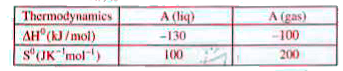
Assuming Delta H^(0) and Delta S^(0) do ...

Assuming `Delta H^(0) and Delta S^(0)` do not change with temperature the boiling point of liquid ''A'' (the thermodynamics data given below) is

A

300K

B

13K

C

150K

D

50K

Text Solution

Verified by Experts

Promotional Banner

Similar Questions

Explore conceptually related problems

Assuming DeltaH^(@) and S^(@) do not change with temperature. Calculate, the boiling point of liquid A using the thermodynamic data given below.

In conversion of limestone to lime , CaCO_3(s) rarrCaO(s)+CO_2(g) the values of DeltaH^@ and DeltaS^@ are +179.1 KJ/mol , 160.2J/K respectively at 298 K and 1 bar. Assuming that DeltaH^@ and DeltaS^@ do not change with temperature , temperature above which conversion of limestone to lime will be spontaneous is

Assuming Delta_(r )H^(Θ) and Delta_(r ) S^(Θ) to be independent of temperature, at what temperature will the reaction given below becomes spontaneous ? {:(,N_(2)(g),+,O_(2)(g),rarr,2NO(g),,,Delta_(r )H^(Θ)=180.9 kJ mol^(-1)),(S^(Θ)//JK^(-1)mol^(-1),191.4,,204.9,,210.5,,):}

Sulphur exists in more than one solid form. The stable form at room temperature is rhombic sulphur. But above room temperature the following reaction occurs : S (rhombic) rarr S (monoclinic) If Delta H = 276.144 J at 298 K and 1 atm and Delta G = 75.312 J Assume that Delta H and Delta S do not vary significantly with temperature, calculate T_(eq) , the temperature at which rhombic and monoclinic sulphur exist in equilibrium with each other.

For the vaporisation of water : H_(2)O (I) hArr H_(2)O(g) [1 atm. Pressure] Given : Delta S = 120 JK^(-1) and Delta H =+45.0 kJ . Evaluate the temperature at which liquid water and water vapour are in equilibrium at 1 atm. Pressure-

The value of K for the reaction O_(3)(g)+OH(g) hArr H(g)+2O_(2)(g) Changed from 0.096 at 298 K to 1.4 at 373 K . Above what temperature will the reaction become thermodynamically spontaneous in the forward direction assuming that DeltaH^(ɵ) and DeltaS^(ɵ) values for the reaction do not change with change in temperature? Given that DeltaS_(298)^(ɵ)=10.296 J K^(-1) .

If Delta H gt 0 and Delta S gt 0 , the reaction proceeds spontaneously when :-

Gibbs-Helmoholtz equation relates the free energy change to the enthalpy and entropy changes of the process as (DeltaG)_(PT) = DeltaH - T DeltaS The magnitude of DeltaH does not change much with the change in temperature but the enrgy factor T DeltaS changes appreciably. Thus, spontaneity of a process depends very much on temperature. For the reaction at 298K, 2A +B rarr C DeltaH = 100 kcal and DeltaS = 0.020 kcal K^(-1) . If DeltaH and DeltaS are assumed to be constant over the temperature range, at what temperature will the reaction become spontaneous?

Explain why an organic liquid vaporises at a temperature below its boiling point in steam distillation?

For the reaction Ag_(2)O(s)rarr 2Ag(s)+1//2O_(2)(g) the value of Delta H=30.56 KJ mol^(_1) and Delta S = 66 JK^(-1)mol^(-1) . The temperature at which the free energy change for the reaction will be zero is :-

