Home
Class 12
PHYSICS
A particle A is projected with an initia...

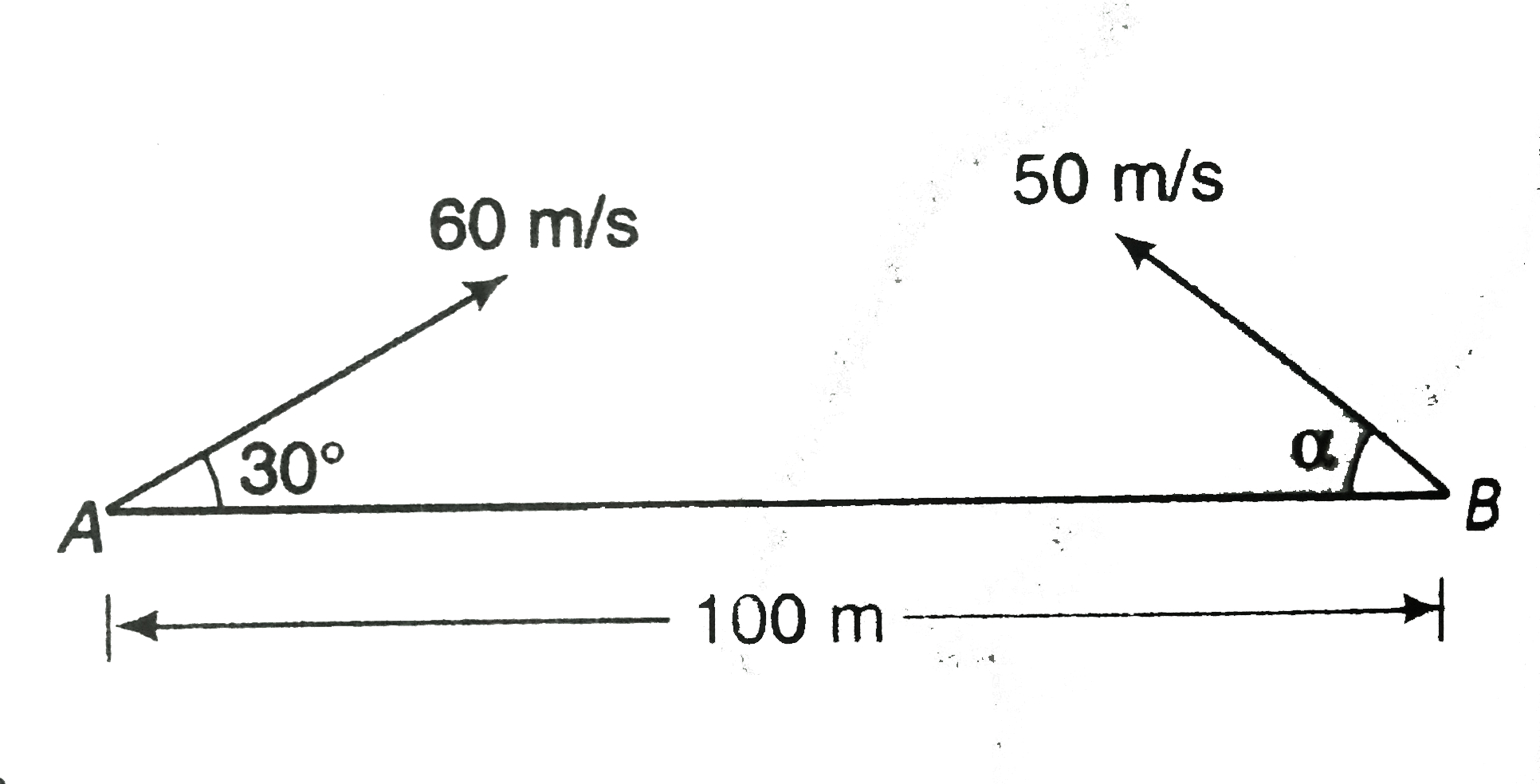
A particle A is projected with an initial velocity of `60 m//s` at an angle `30^@` to the horizontal. At the same time a second particle B is projected in opposite direction with initial speed of `50 m//s` from a point at a distance of 100 m from A. If the particles collide in air, find (a)the angle of projection `alpha` of particle B, (b) time when the collision takes place and (c) the distance of P from A, where collision occurs. `(g= 10 m//s^2)`

Text Solution

Verified by Experts
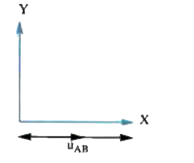
(a) Taking x andy directins as shown in figure
Here , `vec(a)_(A) = - ghat(j)`
`vec(a)_(B) = ghat(j)`
`u_(Ax) = 60 cos 30^(@) = 30 sqrt(3)m/s: u_(Ay) = 60 sin 30^(@) = 30m//s`
`u_(Bx) = - 50 cos alpha and u_(By) = 50 sin alpha`

Relative acceleration between the two is zero as `vec(a_(A)) = vec(a_(B))`. Hence, the relative motion between the two is uniform. Condition of collision is that us should be along AB. this is possible only when `u_(Ay) = u_(By)` i.e., component of relative velocity along y-axis should be zero.
(or) ` 30 = 30 sin alpha " " therefore" alpha = sin^(-1) (3//5)`
(b) Now `|vec(u_(AB)) | =u_(ax) - u_(bx)`
` = (30 sqrt(3)+ 50 cos alpha)m//s = (30 sqrt(3) + 50 xx (4)/(5)) m//s = (30sqrt(3)+40)m//s`
Therefore , time of collision is `t = (AB)/(|vec(u_(AB))|)= (100)/(30sqrt(3)+40) = 1.09s`
(c) Distance of point P form A where collision taken place is .
`s= sqrt((u_(Ax)t)^(2) + (u_(Ay) t-(1)/(2)"gt"^(2))^(2)) = sqrt((30sqrt(3) xx 1.09)^(2) + (30 xx1.09 - (1)/(2)xx10xx1.09xx1.09)^(2)) therefore " " s = 62.64 m`
Promotional Banner

Topper's Solved these Questions

  • MOTION IN A PLANE

    AAKASH SERIES|Exercise SHORT ANSWER TYPE QUESTIONS|6 Videos
  • MOTION IN A PLANE

    AAKASH SERIES|Exercise VERY SHORT ANSWER TYPE QUESTIONS|10 Videos
  • MOTION IN A PLANE

    AAKASH SERIES|Exercise EXERCISE-3 (Circular Motion)|7 Videos
  • MOTION IN A STRAIGHT LINE

    AAKASH SERIES|Exercise very Short answer type question|15 Videos

Similar Questions

Explore conceptually related problems

Two particle are projected with same initial velocities at an angle 30^(@) and 60^(@) with the horizontal .Then

A particle is projected with a velocity 10 m//s at an angle 37^(@) to the horizontal. Find the location at which the particle is at a height 1 m from point of projection.

A particle is projected with velocity of 10m/s at an angle of 15° with horizontal.The horizontal range will be (g = 10m/s^2)

A particle is projected at an angle theta with an initial speed u .

A particle is projected upwards with a velocity of 100 m//s at an angle of 60^(@) with the vertical. Find the time when the particle will move perpendicular to its initial direction, taking g = 10 m//s^(2) .

A particle is projected with velocity v at an angle theta aith horizontal. The average angle velocity of the particle from the point of projection to impact equals

A particle is projected with speed 10 m//s at angle 60^(@) with the horizontal. Then the time after which its speed becomes half of initial.

A particle A is projected from the ground with an initial velocity of 10m//s at an angle of 60^(@) with horizontal. From what height should an another particle B be projected horizontally with velocity 5m//s so that both the particles collide in ground at point C if both are projected simultaneously g=10 m//s^(2) .

A particle is projected with velocity 50 m/s at an angle 60^(@) with the horizontal from the ground. The time after which its velocity will make an angle 45^(@) with the horizontal is

A particle is projected with velocity u at angle theta with horizontal. Find the time when velocity vector is perpendicular to initial velocity vector.

