Home
Class 12
PHYSICS
For an ideal gas, an illustration of thr...

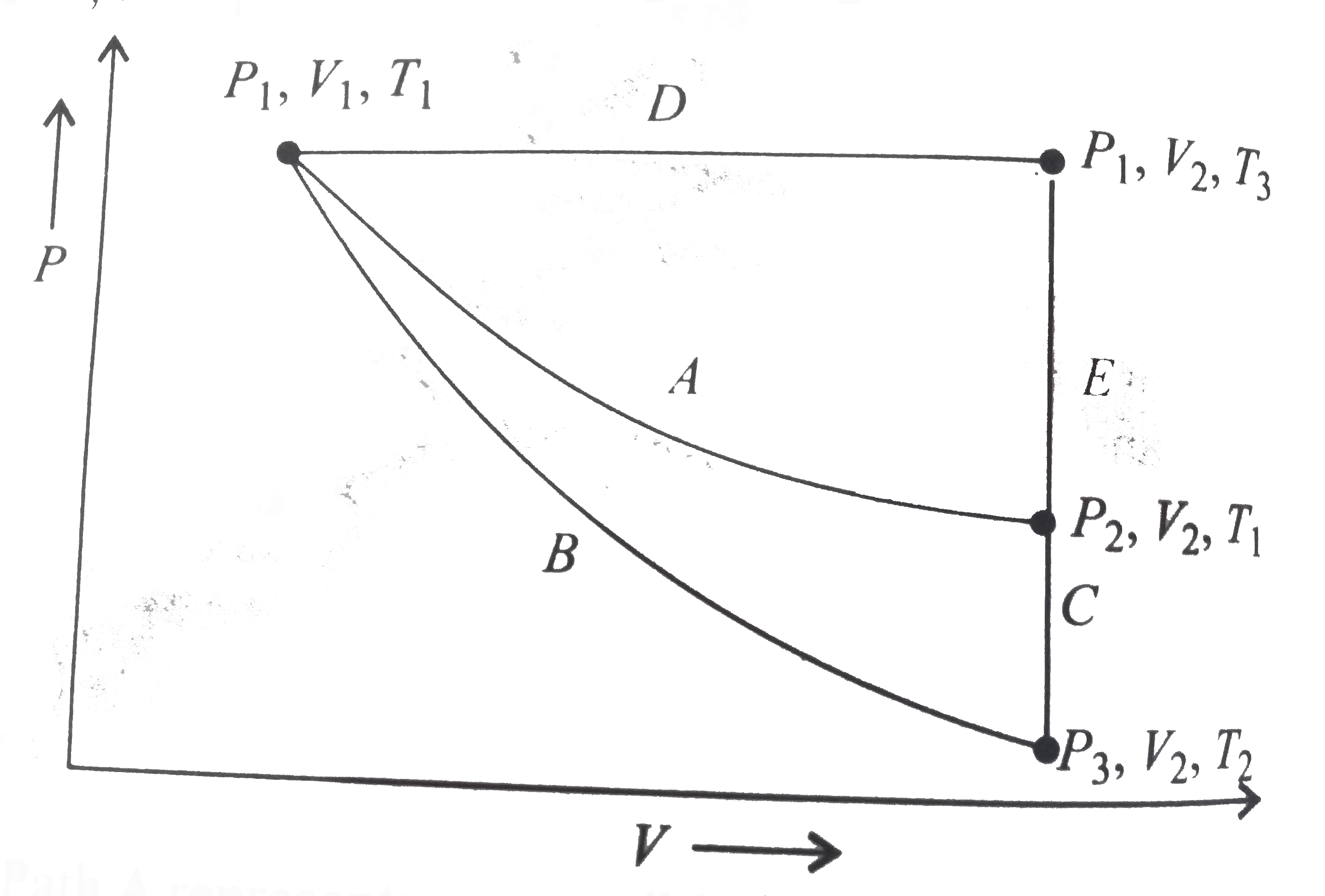
For an ideal gas, an illustration of three different paths `A,(B+C)` and `(D+E)` from an initial state `P_(1), V_(1), T_(1)` to a final state `P_(2), V_(2),T_(1)` is shown in the given figure.

Path `A`represents a reversible isothermal expansion form `P_(1),V_(1)` to `P_(2),V_(2)`, Path `(B+C)` represents a reversible adiabatic expansion `(B)` from `P_(1),V_(1),T_(1)to P_(3),V_(2),T_(2)` followed by reversible heating the gas at constant volume `(C)`from `P_(3),V_(2),T_(2)` to `P_(2),V_(2),T_(1)`. Path `(D+E)` represents a reversible expansion at constant pressure `P_(1)(D)` from `P_(1),V_(1),T_(1)` to `P_(1),V_(2),T_(3)` followed by a reversible cooling at constant volume `V_(2)(E)` from `P_(1),V_(2),T_(3) to P_(2),V_(2),T_(1)`.
What is `q_(rev)`, for path `A`?

A

Stress

B

Young's modulus

C

Pressure

D

all the above

Text Solution

Verified by Experts

The correct Answer is:

D
Promotional Banner

Topper's Solved these Questions

  • UNITS AND MEASUREMENT

    AAKASH SERIES|Exercise EXERCISE - II|61 Videos
  • UNITS AND MEASUREMENT

    AAKASH SERIES|Exercise PRACTICE EXERCISE|45 Videos
  • UNITS AND MEASUREMENT

    AAKASH SERIES|Exercise PRACTICE EXERCISE|45 Videos
  • SEMICONDUCTOR DEVICES

    AAKASH SERIES|Exercise EXERCISE - III|3 Videos
  • UNITS AND MEASUREMENTS

    AAKASH SERIES|Exercise EXERCISE -3|66 Videos

Similar Questions

Explore conceptually related problems

For an ideal gas, an illustratio of three different paths A(B+C) and (D+E) from an initial state P_(1), V_(1), T_(1) to a final state P_(2), V_(2),T_(1) is shown in the given figure. Path A represents a reversible isothermal expansion form P_(1),V_(1) to P_(2),V_(2) , Path (B+C) represents a reversible adiabatic expansion (B) from P_(1),V_(1),T_(1)to P_(3),V_(2),T_(2) followed by reversible heating the gas at constant volume (C) from P_(3),V_(2),T_(2) to P_(2),V_(2),T_(1) . Path (D+E) represents a reversible expansion at constant pressure P_(1)(D) from P_(1),V_(1),T_(1) to P_(1),V_(2),T_(3) followed by a reversible cooling at constant volume V_(2)(E) from P_(1),V_(2),T_(3) to P_(2),V_(2),T_(1) . What is DeltaS for path (D +E) ?

For an ideal gas, an illustratio of three different paths A(B+C) and (D+E) from an initial state P_(1), V_(1), T_(1) to a final state P_(2), V_(2),T_(1) is shown in the given figure. Path A represents a reversible isothermal expansion form P_(1),V_(1) to P_(2),V_(2) , Path (B+C) represents a reversible adiabatic expansion (B) from P_(1),V_(1),T_(1)to P_(3),V_(2),T_(2) followed by reversible heating the gas at constant volume (C) from P_(3),V_(2),T_(2) to P_(2),V_(2),T_(1) . Path (D+E) represents a reversible expansion at constant pressure P_(1)(D) from P_(1),V_(1),T_(1) to P_(1),V_(2),T_(3) followed by a reversible cooling at constant volume V_(2)(E) from P_(1),V_(2),T_(3) to P_(2),V_(2),T_(1) . What is DeltaS for path A ?

A gas with (c_(p))/(c_(V))=gamma goes from an intial state (p_(1), V_(1), T_(1)) to a final state (p_(2), V_(2), T_(2)) through an adiabatic process. The work done by the gas is

A system changes from the state (P_(1),V_(1)) to (P_(2),V_(2)) as shown in the diagram. The work done by the system is

One mole of hydrogen, assumed to be ideal, is adiabatically expanded from its initial state (P_(1), V_(1), T_(1)) to the final state (P_(2), V_(2), T_(2)) . The decrease in the internal energy of the gas during this process will be given by

An ideal gas is expand from (p_(1),V_(1),T_(1)) to (p_(2),V_(2),T_(2)) under different conditions. The correct statement(s) among the following is (are):

Assertion: When ideal gas expand from P_(1), V_(1), T_(1), to P_(2), V_(2), T_(2) two steps, and work done is high in which number of steps are high Reason: Work is path function

For an ideal gas V - T curves at constant pressure P_(1) & P_(2) are shown in figure, from the figure

An ideal gas expands adiabatically from an initial temperature T_(1) to a final temperature T_(2) . Prove that the work done by the gas is C_(V) (T_(1) - T_(2)) .

underset(P_(1), V_(1), T_(1))("State") A overset("Rev")rarr underset(P_(2), V_(2), T_(2))("State B") : If P_(1) = P_(2) then

AAKASH SERIES-UNITS AND MEASUREMENT-EXERCISE - I
  1. The fundamental physical quantities that have same dimensions in the d...

    Text Solution

    |

  2. The thermodynamic property that measures the extent of molecular disor...

    Text Solution

    |

  3. For an ideal gas, an illustration of three different paths A,(B+C) and...

    Text Solution

    |

  4. The dimensional formula for angular momentum is

    Text Solution

    |

  5. The physical quantity that has no dimensions is

    Text Solution

    |

  6. The energy density and pressure have

    Text Solution

    |

  7. The dimensional formula ML^2T^(-2) represents

    Text Solution

    |

  8. The dimensional formula of torque is

    Text Solution

    |

  9. What is the dimensional formula of angular velocity?

    Text Solution

    |

  10. What is meant by faraday 's constant?

    Text Solution

    |

  11. Which of the following is the most precise instrument for measuring le...

    Text Solution

    |

  12. The value of g at depth h is two third the value that on the earth's ...

    Text Solution

    |

  13. The errors due to imperfect design or calibration of the measuring ins...

    Text Solution

    |

  14. For example, if you , by habit, always hold your head a bit too far to...

    Text Solution

    |

  15. By improving experimental techniques, selecting better instruments and...

    Text Solution

    |

  16. Unpredicatable fluctuations in temperature, voltage supply, mechanical...

    Text Solution

    |

  17. In a measurement, a choice of change of different units

    Text Solution

    |

  18. Zero error in an instrument introduces

    Text Solution

    |

  19. Which of the following is systematic error

    Text Solution

    |

  20. (A) : Increasing the number of observations minimizes random errors. ...

    Text Solution

    |
