Text Solution
Verified by Experts




Topper's Solved these Questions
MOTION IN A PLANE
AAKASH SERIES|Exercise SHORT ANSWER TYPE QUESTIONS|6 VideosMOTION IN A PLANE
AAKASH SERIES|Exercise VERY SHORT ANSWER TYPE QUESTIONS|10 VideosMOTION IN A PLANE
AAKASH SERIES|Exercise EXERCISE-3 (Circular Motion)|7 VideosMOTION IN A STRAIGHT LINE
AAKASH SERIES|Exercise very Short answer type question|15 Videos
Similar Questions
Explore conceptually related problems
AAKASH SERIES-MOTION IN A PLANE-QUESTION FOR DESCRIPTIVE ANSWER
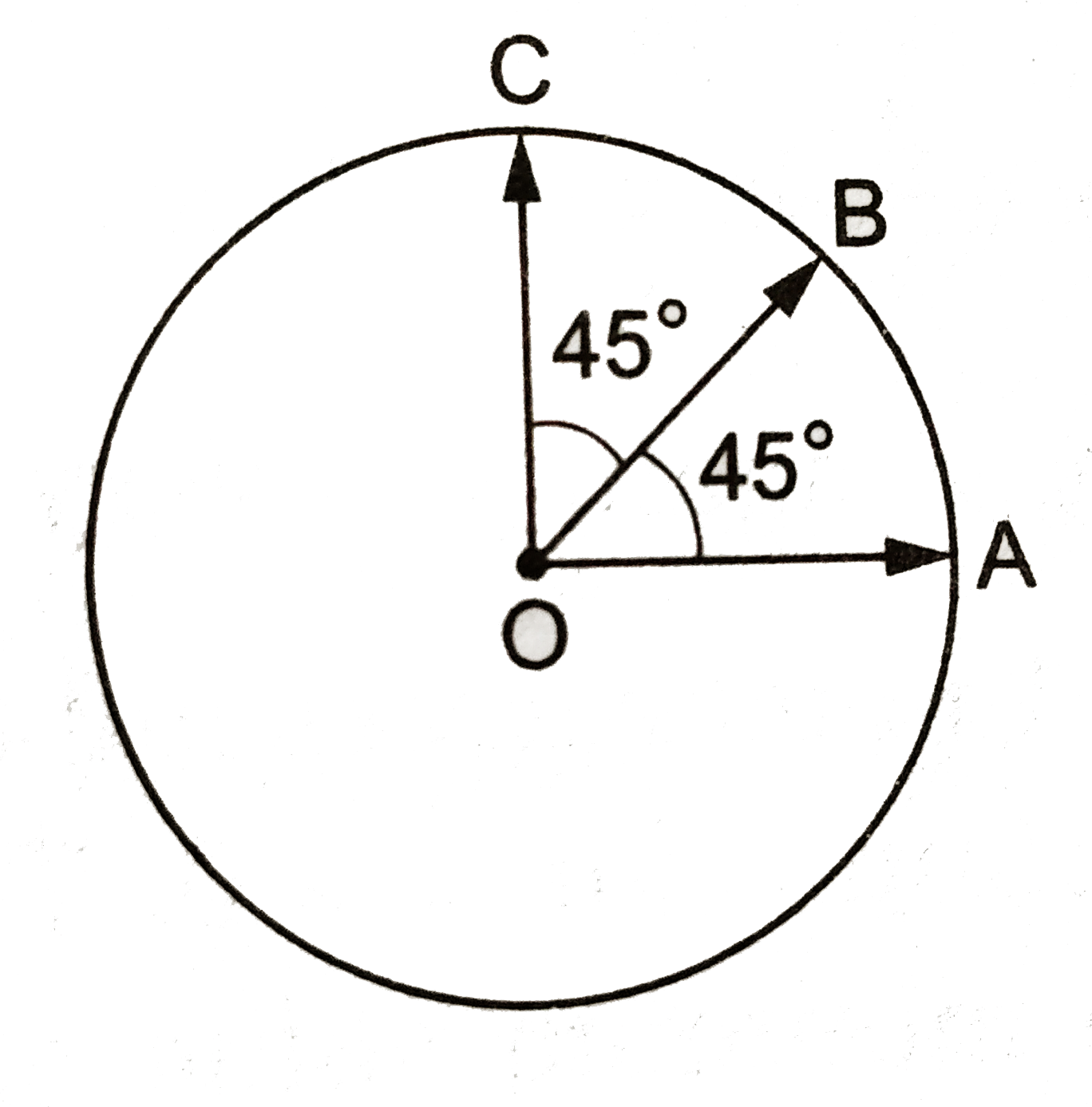
- Find the resultant of the three vectors vec(OA), vec(OB) and vec(OC) s...
Text Solution
|
- A particle is thrown over a triangle from one end of a horizontal base...
Text Solution
|
- A particle is projected at an angle alpha with horizontal from the foo...
Text Solution
|
- A stone is projected from the ground in such a direction so as to hit ...
Text Solution
|
- A stone must be projected horizontally from a point P, which is h ...
Text Solution
|
- A gun is mounted on a gun carriage movable on a smooth plane the gun...
Text Solution
|
- A regular hexagon of side a has a charge Q at each vertex. Potential a...
Text Solution
|
- A projectile is given an initial velocity of (hati+2hatj) m//s, where ...
Text Solution
|