Home
Class 12
PHYSICS
A projectile of mass 2 kg has velocities...

A projectile of mass 2 kg has velocities 3 m/s and 4 m/s at two points during its flight in the uniform gravitational field of the earth. If these two velocities are perpendicular to each other, then the minimum kinetic energy of the particle during its flight is:

Text Solution

Verified by Experts
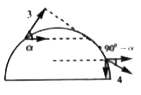

`V_(1)cos alpha =V_(2)cos(90-alpha)`
`3cos alpha=4 sin alpha`
`tan alpha =3/4`
`KE_("man") =1/2mv_(1)^(2) cos^(2)alpha`
`1/2 xx 2 xx 3 xx (4/5)^(2) =(9 xx 16)/25 = 5.76` J
Promotional Banner

Topper's Solved these Questions

  • MOTION IN A PLANE

    AAKASH SERIES|Exercise SHORT ANSWER TYPE QUESTIONS|6 Videos
  • MOTION IN A PLANE

    AAKASH SERIES|Exercise VERY SHORT ANSWER TYPE QUESTIONS|10 Videos
  • MOTION IN A PLANE

    AAKASH SERIES|Exercise EXERCISE-3 (Circular Motion)|7 Videos
  • MOTION IN A STRAIGHT LINE

    AAKASH SERIES|Exercise very Short answer type question|15 Videos

Similar Questions

Explore conceptually related problems

A projectile of mass 2kg has velocities 3m//s and 4m/s at two points during its flight in the uniform gravitational field of the earth. If these two velocities are perpendicular to each other, then the minimum kinetic enerty of the particle during its flight is

Two bodies of different masses 2kg and 4kg are moving with velocities 2m//s and 10m//s towards each other due to mutual gravitational attraction. Then the velocity of the centre of mass is

Two rings of radii 5m and 10m move in opposite directions with velocity 20 m/s and 10 m/s respectively, on a conducting curface S. There is a uniform magnetic field of magnitude 0.1T perpendicular to the plane of the rings. Find the potential difference between the highest points of the two rings.

A particle of mass 1 kg has a velocity of 2m//s . A constant force of 2N acts on the particle for 1s in a direction perpendicular to its initial velocity. Find the velocity and displacement of the particle at the end of 1 s.

A projectile is thrown at an angle of 30^(@) with a velocity of 10m/s. the change in velocity during the time interval in which it reaches the highest point is

A particle of mass m has momentum p. Its kinetic energy will be

A body of mass 4 kg moving with velocity 12 m//s collides with another body of mass 6 kg at rest. If two bodies stick together after collision , then the loss of kinetic energy of system is

A body of mass 4 kg moving with velocity 12 m//s collides with another body of mass 6 kg at rest. If two bodies stick together after collision , then the loss of kinetic energy of system is

A car is travelling at a velocity of 10 m/s and has a mass of 850 kg. What is its kinetic energy?

Two smooth spheres A and B of masses 4kg and 8kg move with velocities 9m//s and 3m//s in opposite directions. If A rebounds on its path with velocity 1m//s , then

