Home
Class 12
PHYSICS
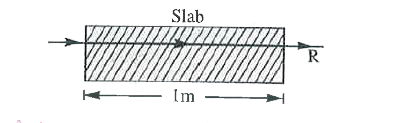
The figure shows a transparent slab of l...

The figure shows a transparent slab of length m placed in air whose refractive index in x direction varies as `mu = 1 + x^(2)(0 lt x lt 1)`. The optical path length of ray R will be

A

1m

B

`(2)/(3)m`

C

`(4)/(3)m`

D

`sqrt(2)m`

Text Solution

Verified by Experts

The correct Answer is:

C
Promotional Banner

Topper's Solved these Questions

  • WAVE OPTICS

    AAKASH SERIES|Exercise Practice Sheet (Exercise - I) (INTERFERENCE & YDSE) (Level - II (Advanced) More than one correct answer type questions|2 Videos
  • WAVE OPTICS

    AAKASH SERIES|Exercise Practice Sheet (Exercise - I) (INTERFERENCE & YDSE) (Level - II (Advanced) Linked Comprehension Type Questions|3 Videos
  • WAVE OPTICS

    AAKASH SERIES|Exercise Practice Sheet (Exercise - I) (INTERFERENCE & YDSE) (Level - 1 (Main) Straight Objective Type questions|11 Videos
  • WAVE MOTION AND SOUND

    AAKASH SERIES|Exercise PROBLEMS (LEVEL - II)|97 Videos
  • WAVES

    AAKASH SERIES|Exercise EXERCISE-III (Doppler effect :)|15 Videos

Similar Questions

Explore conceptually related problems

The lens governing the behavior of the rays namely rectilinear propagation laws of reflection and refraction can be summarised in one fundamental law known as Fermat's principle. According to this principle a ray of light travels from one point to another such that the time taken is at a stationary value (maximum or minimum). if c is the velocity of light in a vacuum the velocity in a medium of refractive index mu is (c)/(mu) hence time taken to travel a distance l is (mul)/(c) if the light passes through a number of media, the total time taken is ((1)/(c))summul or (1)/(c)intmudl if refractive index varies continuously. Now summul is the total path, so that fermat's principle states that the path of a ray is such that the optical path in at a stationary value. this principle is obviously in agreement with the fact that the ray are straight lines i a homogenous isotropic medium. it is found that it also agrees with the classical laws of reflection and refraction. Q. If refractive index of a slab varies as mu=1+x^(2) where x is measured from one end then optical path length of a slab of thickness 1 m is

The figure ,shows a transparent sphere of radius R and refractive index mu .An object O is placed at a distance x from the pole of the first surface so that a real image is formed at the pole of the exactly opposite surface. If x=2R ,then the value of mu is

The figure ,shows a transparent sphere of radius R and refractive index mu .An object O is placed at a distance x from the pole of the first surface so that a real image is formed at the pole of the exactly opposite surface. If x=oo ,then the value of mu is

Solve x^(2)-x-1 lt 0 .

Light travels in a mica sheet of refractive index 1.4 and length 10 cm. Find the optical path equivalent to length of the sheet.

An equi-convex lens of focal length 10 cm and refractive index ( mu g=1.5) is placed in a liquid whose refractive index varies with time as mu ( t ) = 1.0 + ( 1 ) /( 10) t . If the lens was placed in the liquid at t = 0, after what time will the lens act as concave lens of focal length 20 cm?

y = cos ^(-1)((1 - x^(2))/(1+ x^(2))) 0 lt x lt 1

A lens made of material of Refractive index mu_(2) is surrounded by a medium of Refractive Index mu_(1) . The focal length f is related as

A lens made of material of Refractive index mu_(2) is surrounded by a medium of Refractive Index mu_(1) . The focal length f is related as

The given figure shows a convergent lens placed inside a cell filled with liquid. The lens has focal length +20 cm when in air , and its metrial has refractive index 1.50 . If the liquid has refractive index 1.60 , then focal length of the lens in the cell is
