Home
Class 12
PHYSICS
A solid sphere of mass 2 kg is resting i...

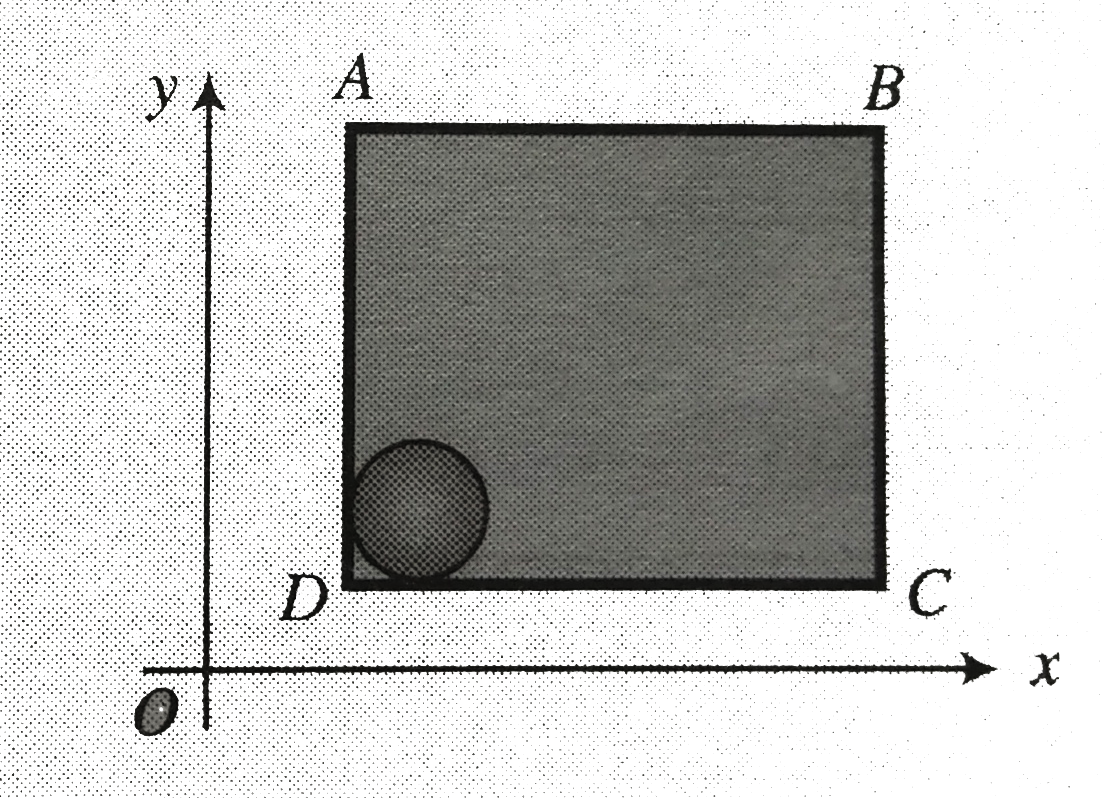
A solid sphere of mass 2 kg is resting inside a cube as shown in fig. The cube is moving with a velocity `vec(v)=(5t hat(i)+2t hat(j))ms^(-1)`. Here t is time in seconds. All surface are smooth. The sphere is at rest with respect to the cube. What is the total force exerted by the sphere on the cube?

Text Solution

Verified by Experts

`v=5ti + 2tj , bar(a) = (dv)/(dt) = 5i + 2j`
` F = ma_x hati + m(g +a_y) hatj , F=2(5i) + 2[10+2]hatj` ,
`F=10i + 25 j , F= sqrt(100 + 567) = sqrt(676) = 26N`
Promotional Banner

Similar Questions

Explore conceptually related problems

A solid block of mass 2 kg is resting inside a cube shown in figure The cube is moving with a velocity hatv= 5 hati + 2hatj ms^(-1) If the coefficient of friction between the surface of cube and block is 0.2 then the force of friction between the block and cube is

A sphere of mass 1 kg rests at one corner of a cube. The cube is moved with a velocity v =(8 t hat(i) - 2t^(2)) hat(j) , where t is time in second . The force by sphere on the cube at t = 1 s is (g = 10 m//s^(-2)) [figure shown vertical plane of the cube]

Velocity of a particle moving in a curvilinear path varies with time as v=(2t hat(i)+t^(2) hat(k))m//s . Here t is in second. At t=1 s

A small sphere of mass 1 kg is moving with a velocity (6hat(i)+hat(j))ms^(-1) . It hits a fixed smooth wall and rebound with velocity (4hat(i)+hat(j))ms^(-1) . The coefficient of restitution between the sphere and the wall is

An object of mass 2 kg at rest at origin starts moving under the action of a force vec(F)=(3t^(2)hat(i)+4that(j))N The velocity of the object at t = 2 s will be -

A body with mass 5 kg is acted upon by a force vec(F) = (- 3 hat (i) + 4 hat (j)) N . If its initial velocity at t =0 is vec(v) = (6 hat(i) - 12 hat (j)) ms^(-1) , the time at which it will just have a velocity along the y-axis is :

In a particular crash test, a car of mass 1500 kg collies with a wall as shown in fig. The initial and final velocities on the car are vec(v_i)=-15.0 hat(i)ms^(-1) and vec(v_f)=5.00 hat(i) ms^(-1) , respectively. If the collision lasts 0.150s , find the impulse caused by the collision and the average force exerted on the car.

A body with mass 5 kg is acted upon by a force vec(F) = (- 3 hat (i) + 4 hat (j)) N . If its initial velocity at t =0 is vec(v) = 6 hat(i) - 12 hat (j) ms^(-1) , the time at which it will just have a velocity along the y-axis is :

A body with mass 5 kg is acted upon by a force vec(F) = (- 3 hat (i) + 4 hat (j)) N . If its initial velocity at t =0 is vec(v) = 6 hat(i) - 12 hat (j) ms^(-1) , the time at which it will just have a velocity along the y-axis is :

A body of mass 5 kg statrs from the origin with an initial velocity vec(u) = (30 hat(i) + 40 hat(j)) ms^(-1) . If a constant force (-6 hat(i) - 5 hat(j))N acts on the body, the time in which the y component of the velocity becomes zero is
