Home
Class 12
PHYSICS
A smooth pulley A of mass M(0) is lying ...

A smooth pulley A of mass `M_(0)` is lying on a frictionless table. A massless rope passes round the pulley and has masses `M_(1)` and `M_(2)` tied to its ends, the two portions of the string being perpendicular to the edge of the table so that the masses hang vertically. Find the acceleration of the pulley.

Text Solution

Verified by Experts
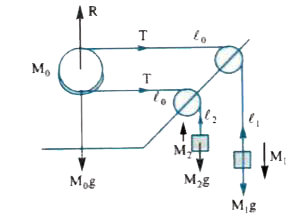
Let the length of portions of string on the table be `l_0 , l_1 and l_2` as shown in figure .
Let mass `M_0` move to the right by x on the table , `M_1` goes down by `y_1 and M_2` goes up by `y_2` .
Then `l_0` becomes `(l_0 -x),l_1` becomes ` (l_1 + y_1) and l_2` becomes ` (l_2 - y_2)`.
As the length of string remains unchanged
` 2l_0 + l_1 + l_2 = 2(l_0 -x) + l_1 + y_1 + l_2 - y_2`
or ` 2 x = y_1 -y_2`
Diff. twice w.r. to t,
we get ` 2(d^(2)x)/(dt^(2)) = (d^(2) y_1)/(dt^(2)) - (d^(2)y_2)/(dt^(2))`
If ` a_0 , a_1 and a_2` are acceleration of

`M_0 , M_1 and M_2 ` respectively , then
` 2a_0 = a_1 - a_2` ......... (1)
For motion of `M_0 , 2T= M_0a_0` ....... (2)
`M_1g-T=M_1 a_1`....... (3)
For motion of mass `M_2` ,
` T-m_2g = M_2a_2` .......... (4)
Substituting values of ` a_0 , a_1 and a_2` from (2) , (3) and (4) in equation (1) , we get
` 2((2T)/(M_0))=(g-(T)/(M_1)) -((T)/(M_2)-g)`,
`(4T)/(M_0)= 2g-T((1)/(M_1) + (1)/(M_2)) i.e., ((4)/(M_0) + (1)/(M_1) + (1)/(M_2))T=2g `
This gives `T=(2M_0 M_1 M_2g)/(4M_1M_2+ M_0 (M_1 + M_2))`........ (5)
`:.` Acceleration of puelly A from (2)
`a_0 = (2T)/(M_0) = (4M_1M_2 g)/( 4M_1 M_2 + M_0(M_1 + M_2))` ............ (6)
Promotional Banner

Similar Questions

Explore conceptually related problems

Two bodies of masses 4 kg and 6 kg are tied to the ends of a massless string. The string passes over a frictionless pulley. The acceleration of the system is :

A block of mass 20 kg is set into motion on a frictionless horizontal surface with the help of massless smooth pulley and rope as shown in the figure. Find the acceleration of the pulley

A pulley fixed to the ceiling carried a thread with bodies of masses m_(1) and m_(2) attached to its ends. The mases of the pulley and the thread are negligible and friction is absent. Find the acceleration of the centre of mass of this system.

The pulley A and C are fixed while the pulley B is movable. A mass M_2 is attached to pulley B , while the string has masses M_1 and M_3 at the two ends. Find the acceleration of each mass .

In the arrangement shown in fig. pulleys are smooth and massless. Threads are massless and inextensible. Find acceleration of mass m_(1) .

A block of mass of 20kg is set into motion on a frictionless horizontal surface with the help of massless smooth pulley and rope as shown in figure.Find the acceleration of the pulley .jpg

Two mass m_(1) and m_(2) are attached to a flexible inextensible massless rope, which passes over a frictionless and massless pully. Find the accelerations of the masses and tension in the rope.

In the arrangement shown, the mass m will ascend with an acceleration ( Pulley and rope are massless)

In the arrangement shown, the mass m will ascend with an acceleration ( Pulley and rope are massless)

A block of mass m_(1) rests on a horizontal table. A string tied to the block is passed on a frictionless pulley fixed at the end of the table and to the other end of string is hung another block of mass m_(2) . The acceleration of the system is

