Home
Class 12
PHYSICS
A block of mass m is arranged on the wed...

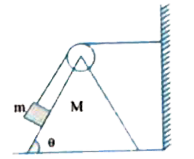
A block of mass m is arranged on the wedge as shown in figure . The wedge angle is ` theta `. If the masses of pulley and thread and negligible and friction is absent , find the acceleration of the wedge

Text Solution

Verified by Experts

It is obvious that when block m moves downward along the incline of wedge , the wedge moves to the right . As the length of thread is constant , the distance traversed by wedge along the incline is equal to distance traversed by wedge to the right. This implies that acceleration of wedge to the right is equal to downward acceleration of wedge .
Let a be the acceleration of wedge to the right.
Then the force acting on the block m are
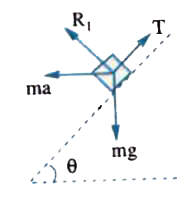
i) weight mg acting vertically downward
ii) normal reaction `R_1`
iii) tenstion T ( up the incline )
iv) Fictitious force ma to the left .
The free body diagram of mass m is shown in figure .
For motion of block .m. on inclined plane
`mg sin theta + ma cos theta -T = ma `.......... (1)
As mass .m. does not breaks off the inclined plane, therefore for forces on ..m. normal to inclined plane
`R_1 + ma sin theta = mg cos theta `.......... (2)
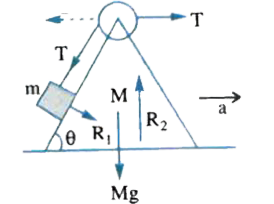
The forces acting on the wedge are
i) weight Mg downward
ii) normal reaction of ground on wedge =`R_2`
iii) normal reaction of block on wedge `=R_1`
iv) tension (T,T) in string .
The free body diagram of wedge is shown in figure .
For maotion of wedge in horizontal direction
`R_1 sin theta = T-T cos theta = Ma`......... (3)
For vertical equilibrium of wedge on surface
`R_2 = R_1 cos theta + T sin theta + Mg `.......... (4)
From (1) ,
`T= mg sin theta + ma cos theta - ma `........ (5)
From (2) , `R_1 = mg cos theta - ma sin theta `............. (6)
substituting these values in (3) , we get
`(mg cos theta - ma sin theta ) sin theta + (mg sin theta + ma cos theta - ma) (1- cos theta ) = Ma`
`or { M + msin^2 theta + m(1- cos theta )^(2)}a`
`= ma cos theta sin theta + mg sin theta (1-cos theta )`
` a= ( mg sin theta )/( M + m sin^(2) theta + m(1- 2 cos theta + cos^(2) theta)) = ( mg sin theta )/( M + m(sin^2 theta + 1 -2 cos theta + cos^(2) theta ))`
` :. a=(mg sin theta )/( M + 2m(1-cos theta))`
Promotional Banner

Similar Questions

Explore conceptually related problems

A block of mass m is at rest on a rought wedge as shown in figure. What is the force exerted by the wedge on the block?

A block of mass m is at rest on a rough wedge as shown in figure. What is the force exerted by the wedge on the block?

A block of mass m is at rest on a rough wedge as shown in figure. What is the force exerted by the wedge on the block?

A pulley fixed to the ceiling carried a thread with bodies of masses m_(1) and m_(2) attached to its ends. The mases of the pulley and the thread are negligible and friction is absent. Find the acceleration of the centre of mass of this system.

A block of mass m is released from a wedge of mass m as shown in figure . Find the time taken by the block to reach the end of the wedge.

A block of mass 'm' is kept on a smooth moving wedge. If the acceleration of the wedge is 'a'

A block of mass 2kg slides down the face of a smooth 45^@ wedge of mass 9 kg as shown in the figure. The wedge is placed on a frictionless horizontal surface. Determine the acceleration of the wedge.

A block of mass m is placed on a smooth wedge of mass M, as shown in the figure . Just after placiing block m over wedge M.

A block of mass m is placed on a smooth wedge of inclination Q. The whole system is accelerated horizontally so that the block does not slip on the wedge. Find the i) Acceleration of the wedge ii) Force to be applied on the wedge iii) Force exerted by the wedge on the block.

A ball of mass m is released from A inside a smooth wedge of mass m as shown in figure. What is the speed of the wedge when the ball reaches point B?

