Home
Class 12
PHYSICS
Two clocks are being tested against a st...

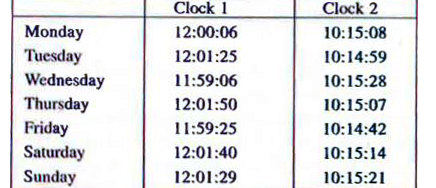
Two clocks are being tested against a standard clock located in a national laboratory. At 12:00:00 noon by the standard clock, the readings of the two clocks are :

If you are doing an experiment that requires 'precision time interval' measurements , which of the two clocks will you prefer ?

Text Solution

Verified by Experts

The range of viriation over the Neven days of observations is 164s for clock-1. and 32 s for clock 2. The average reading of clock I is much closer to the standard time than the average reading of clock 2.
The important point is that a clock is zero error is not as significant tor precision work as its variation. because a zero -error can always be easily corrected . Hence clock 2 is to be preferred to clock 1.
Promotional Banner

Topper's Solved these Questions

  • UNITS AND MEASUREMENTS

    AAKASH SERIES|Exercise EXERCISE -1 A|187 Videos
  • UNITS AND MEASUREMENTS

    AAKASH SERIES|Exercise EXERCISE- 1 B|28 Videos
  • UNITS AND MEASUREMENTS

    AAKASH SERIES|Exercise QUESTIONS FOR DESCRIPTIVE ANSWERS|7 Videos
  • UNITS AND MEASUREMENT

    AAKASH SERIES|Exercise PRACTICE EXERCISE|45 Videos
  • WAVE MOTION

    AAKASH SERIES|Exercise PRACTICE SHEET ADVANCED (INTEGER TYPE QUESTIONS)|10 Videos

Similar Questions

Explore conceptually related problems

Two clocks are being tsted against a standard clock located in the national laboratory. At 10: 00: 00 AM by the standard clock, the readings of the clocks are : If you are doing an experiment that requires prescision time interval measurements, which of the two clock will you prefer ? (a) Clock A (b) Clock B (c) Either Clock A or B (d) Neithr A nor B

Two clocks are being tested against a standard clock located in a national laboratory .At 12:00:00 noon by the standard clock, the readings of the two clocks are {:(,"Day 1","Day 2","Day 3","Day 4" , "Day 5"),("Clock 1",12:00:04,12:02:19,12:01:50,11:59:04,11:59:08),("Clock 2",11:15:24,11:15:01,11:14:59,11:15:00,11:14:58):} Which of the two clocks will you prefer to measure the time intervals during an experiment ?

Two clocks are being tested against a standard clock located in a national laboratory At 12 : 00 : 00 noon by standard clock, the readins of the two clocks are {:("Day","Clock - I","Clock - II"),("Monday",12:00:05,10:15:06),("Tuesday",12:01:15,10:14:59),("Wednesday",11:59:08,10:15:18),("Thursday",12:01:50,10:15:07),("Thursday",12:01:50,10:15:07),("Friday",11:59:15,10:14:53),("Saturday",12:01:30,10:15:24),("Sunday",12:01:19,10:15:11):} From the Observations carefully read the following conclusive statements. Statement I : Zero - error in clock II is much longer than zero - error in clock I. Statement II : Zero - error can always be corrected by applying necessary corrective measures Statement III : Precision of clock - I is more than precision of clock - II Statement IV : Precision of clock - II is more than precision of clock - I Pick up the correction option from the following.

Two clocks A and B being tested against a standard clock located in the national laboratory At 10.00 AM by the standard clock, the readings of the two clocks are shown in following table {:("Day","Clock A","Clock B"),(I^("st"),10:00:06,8:15:00),(II^("nd"),10:01:13,8:15:0.1),(III^("rd"),9:59:0.8,8:15:04),(IV^("th"),10:02:15,8:14:58),(V^("th"),9:58:10,8:15:02):} If you are doing an experiment that requires precision time interval measurements, which of the two clocks will you prefer ?

The angle is degree measure between two hands of a clock at 8 : 30 p.m. is

It is claimed that two atomic clocks if allowed to run for 100 years, free from any disturbance, may differ by only about 0.02 second. In measuring a time interval of second what is the accuracy?

AAKASH SERIES-UNITS AND MEASUREMENTS-PROBLEM
  1. If the size of a nucleus (in the range of 10^(-15) to 10^(-14) m) is s...

    Text Solution

    |

  2. The length of a straight line is measured a number of times by a numbe...

    Text Solution

    |

  3. Two clocks are being tested against a standard clock located in a nati...

    Text Solution

    |

  4. In an experiment the valno of refractive index of glass was found to b...

    Text Solution

    |

  5. The readings of a length come out to be 2.63 m , 2.56 m , 2.42 m , 2.7...

    Text Solution

    |

  6. If L = 2.06 cm pm 0.02 cm , B = 1.11 cm pm 0.03 cm . What are (L+B) an...

    Text Solution

    |

  7. Two objects A and B are of lengths 5 cm and 7cm determined with errors...

    Text Solution

    |

  8. If L = 2.01 m pm 0.01 m , what is 3 L ?

    Text Solution

    |

  9. If L1 = 2.02 m pm 0.01 m , L2 = 1.02 m pm 0.01 m , determine L1 + 2L2

    Text Solution

    |

  10. The length and breadth of a rectangular object are 25.2 cm and 16.8 cm...

    Text Solution

    |

  11. In an experiment to determine the value of acceleration due to gravity...

    Text Solution

    |

  12. If L = 20.04 m pm0.01 m , B= 2.52 m pm 0.02 m . What are the values o...

    Text Solution

    |

  13. One side of a cube is measured as a=4.03pm 1%. What is its value?

    Text Solution

    |

  14. The density of a cube is measured by measuring its mass and the length...

    Text Solution

    |

  15. An experiment measured quantity a, b, c and then x is calculated from ...

    Text Solution

    |

  16. If error in measurement of radius of a sphere is 1%, what will be the ...

    Text Solution

    |

  17. A rectangular metal slab of mass 33.333 g has its length 8.0 cm, bread...

    Text Solution

    |

  18. The percentage errors in the measurement of mass and speed are 2% and ...

    Text Solution

    |

  19. The error in the measurement of the length of a simple pendulum is 0.1...

    Text Solution

    |

  20. Two resistors of resistances R1 = 100 pm 3 ohm and R2 = 200 pm 4 ohm ...

    Text Solution

    |
