Text Solution
Verified by Experts



Topper's Solved these Questions
MOTION IN A PLANE
AAKASH SERIES|Exercise EXERCISE-A (Vectors & Scalars)|25 VideosMOTION IN A PLANE
AAKASH SERIES|Exercise EXERCISE-A (Addition & Subtractions of Vectors)|10 VideosMAGNETISM
AAKASH SERIES|Exercise ADDITIONAL EXERCISE|22 VideosMOTION IN A PLANE
AAKASH SERIES|Exercise QUESTION FOR DESCRIPTIVE ANSWER|7 Videos
Similar Questions
Explore conceptually related problems
AAKASH SERIES-MOTION IN A PLANE-EXERCISE-3 (Circular Motion)
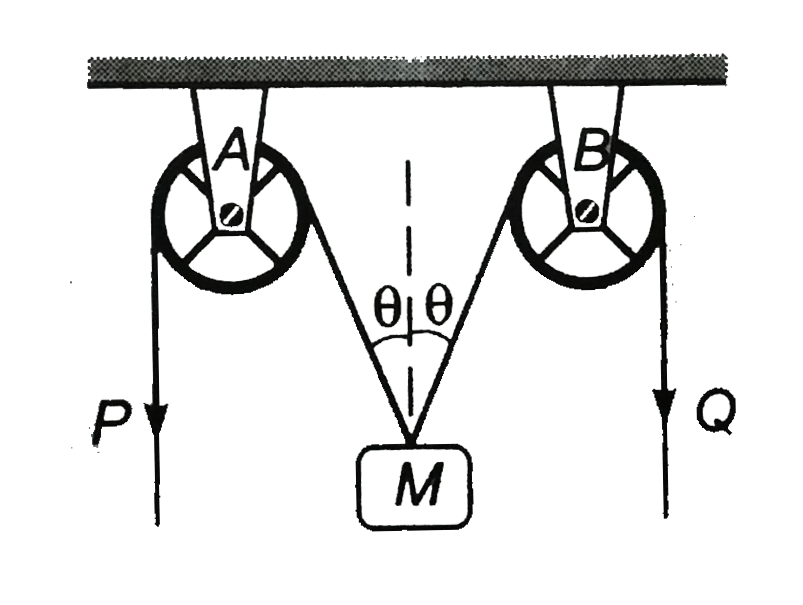
- In the arrangement shown in figure, the ends P and Q of an unstretchab...
Text Solution
|
- A particle 'P' is moving in a circle of radius 'a' with a uniform spee...
Text Solution
|
- Starting from rest a wheel rotates with uniform angular acceleration 2...
Text Solution
|
- A cyclist is riding with a speed of 27 kmh^(-1) . As he approaches a c...
Text Solution
|
- A particle is moving along a circular path in xy-plane. When it crosse...
Text Solution
|
- A particle moves on a circle of radius r with centripetal acceleration...
Text Solution
|
- The position vector of a particle R as a function of time is given b...
Text Solution
|
- A particle moves in a circular path such that its speed v varies with...
Text Solution
|