Home
Class 12
PHYSICS
The block A is moving downward with cons...

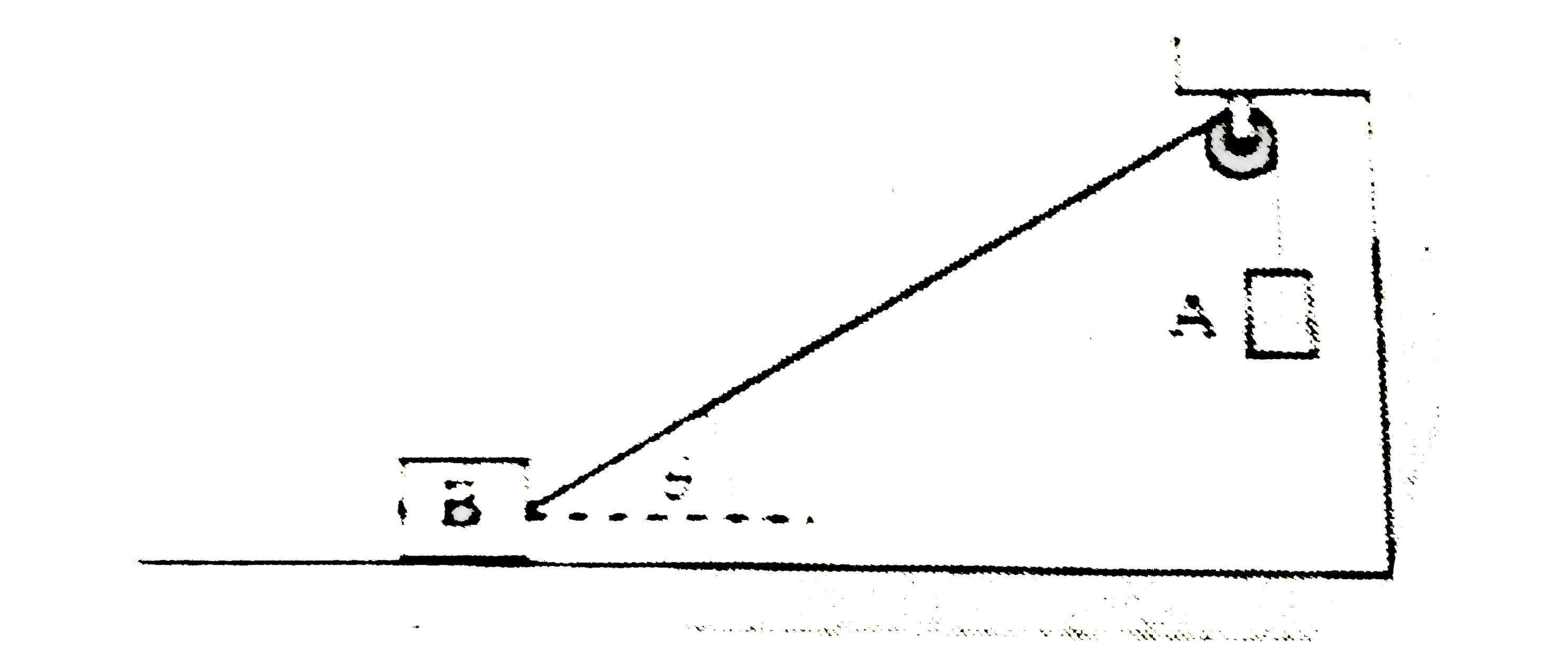
The block A is moving downward with constant velocity `v_(0.)` Find the velocity of the block B. When the string makes an angle `theta` with the horizontal

Text Solution

Verified by Experts

In such type of problems, when velocity of one part of a body is given and that of other is required, we first find the relation between the two displacements, then differentiate them with respect to time. Here if the distance from the corner to the point is x and up to B is y. Then `v=(dx)/(dt)& v_(B)=(dy)/(dt)`
(-sign denotes that y is decreasing)
`2x(dx)/(dt)+2y(dy)/(dt)=0 " " xv= yv_(B)`
`v_(B)=(v)=(x)/(y) v cot theta`
Promotional Banner

Topper's Solved these Questions

  • MOTION IN A PLANE

    AAKASH SERIES|Exercise EXERCISE-A (Vectors & Scalars)|25 Videos
  • MOTION IN A PLANE

    AAKASH SERIES|Exercise EXERCISE-A (Addition & Subtractions of Vectors)|10 Videos
  • MAGNETISM

    AAKASH SERIES|Exercise ADDITIONAL EXERCISE|22 Videos
  • MOTION IN A PLANE

    AAKASH SERIES|Exercise QUESTION FOR DESCRIPTIVE ANSWER|7 Videos

Similar Questions

Explore conceptually related problems

Figure shows a rod of length l resting on a wall and the floor. Its lower end A is pulled towards left with a constant velocity v. Find the velocity of the other end B downward when the rod makes an angle theta with the horizontal.

If block A is moving horizontally with velocity v_(A) , then find the velocity of block B at the instant as shown in fig.

The block shown is moving with constant velocity. Find mu_(k) between the block and the surface.

Block B moves to the right with a constant velocity v_(0) . The velocity of body a relative to b is

In the block moves up with constant velocity v m/s. Find F

A simple pendulum is released from rest with the string in horizontal position. The vertical component of the velocity of the bob becomes maximum, when the string makes an angle theta with the vertical. The angle theta is equal to

In the system shown, the block A is moving down eith velocity v_(1) and C is moving up with velocity v_(3) . Express velocity of the block B in terms of velocities of the blocks a and C.

A rod of length 'l' is inclined at an angle 'theta' with the floor against a smooth vertical wall. If the end A moves instantaneously with velocity v_(1) , what is the velocity of end B at the instant when rod makes 'theta' angle with the horizontal.

A block A of mass 5 sqrt( 3) m rests on a rough horizontal plane relative to which its coefficient of friction is mu A light string attached to this block passes over a light frictionless pulley and another block B of mass m hangs from it. It is observed that the block A just slips when the string makes an angle of 60^(@) with the horizontal . Find the coefficient of static friction between the block A and the plane. If the same force acting through the sting is applied to the block A in the horizontal direction, find the acceleration of the block A.

Two masses M and m are connected by a light inextensible string which passes over a small pulley as shown in the diagram. If the mass m is moving downward with a velocity v when the string makes an angle of 45^(@) with the horizontal, find the total K.E. of the two masses. AsSigmae that the mass M moves horizontally.
