Home
Class 12
PHYSICS
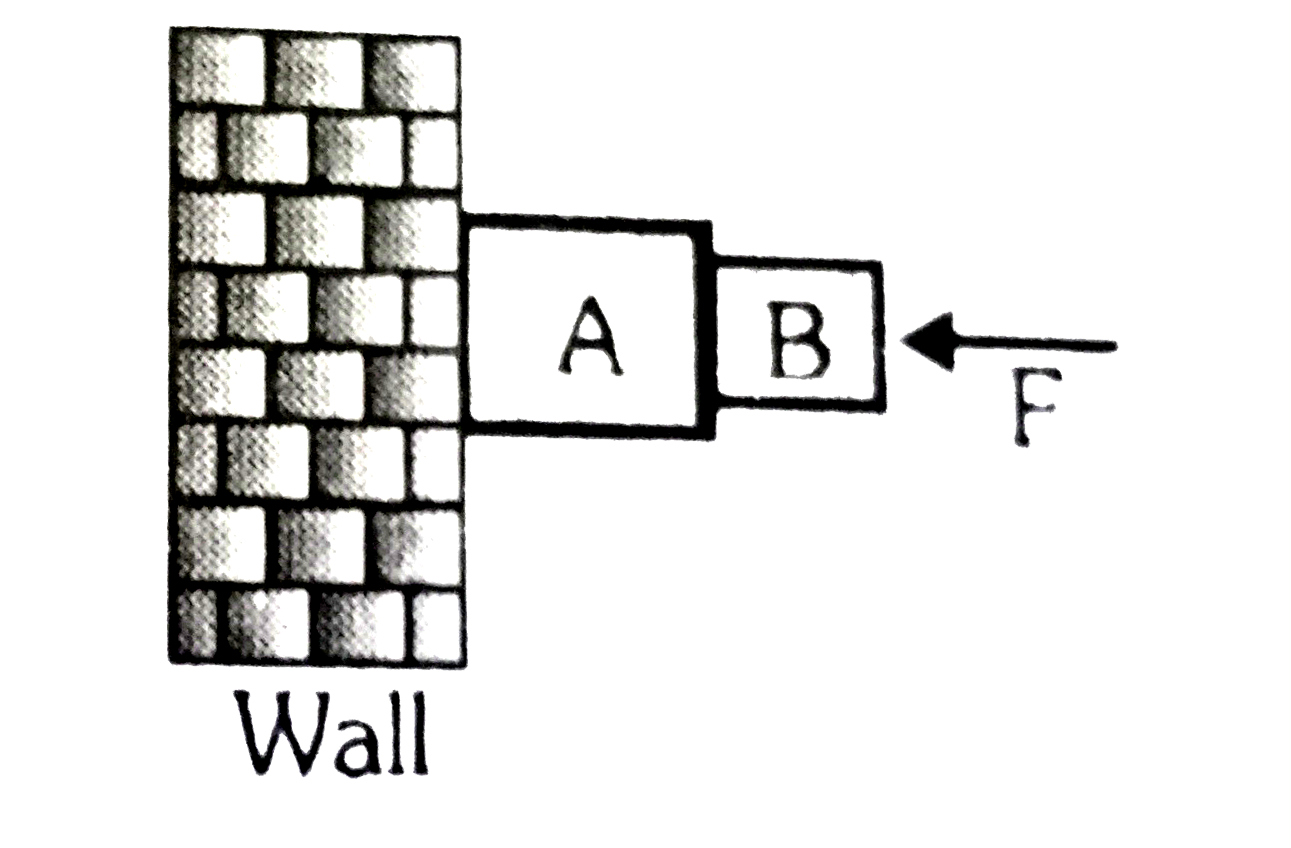
Adjoining figure shows two blocks A and ...

Adjoining figure shows two blocks A and B pushed against the wall with the force F. The wall is smooth but the surfaces in contact of A and B are rough. Which of the following is true for the system of bloods to be at rest against the wall:

A

F should be more than the weight of P & Q

B

F should be equal to the weight of P & Q

C

F should be less then the weight of P & Q

D

The system cannot be in equilibrium

Text Solution

Verified by Experts

The correct Answer is:

D
Promotional Banner

Similar Questions

Explore conceptually related problems

Figure shows two block A and B pushed against the wall with the force F . The wall is smooth but the surfaces in contact of A and B are rough. Which of the following is true for the system of blocks to be at rest againts wall?

Consider the situation shown in figure. The wall is smooth but the surfces of A and B in contact are rough. The friction on B due to A in equilibrium.

Consider the situation shown in figure. The wall and the surface of A and B in contact are rough. The friction on A due to .

A 1 kg block is being pushed against a wall by a force F=75N as shown in the figure. The coefficient of friction is 0.25. The magnitude of acceleration of the block is:

Force 'F' is applied on block 'B' and the system remains at rest . All surface are ruogh , which of the following statement (s) is /are correct

A block of mass 'M' is pressed against a wall with a horizontal force F. Then a) it will slide down if the wall is smooth b) frictional force may balance the weight if the wall is rough c) Normal reaction is equal to weight of the block d) Normal reaction is zero if the wall is smooth

In the diagram the wall and the interface between blocks B and C are smooth. The value of F required to keep the whole system stationary is :

A block of mass m is at rest under the action of force F against a wall as shown in figure. Which of the following statement is incorrect?

Two blocks A and B are pressed against a vertical wall by applying a horizontal force T" as shown in the figure. There is no friction between A and B. Then a) Both the blocks A and B can be at rest for any magnitude of F b) B can be at rest A moves down for smaller magnitude of F c) Both A and B will move down for smaller magnitude d) A can be at rest and B moves down for larger magnitude of F.

The figure above shows a 14 - foot ramp that forms an angle of 63^(@) with the vertical wall it is leaning against. Which of the following is an expression for the horizontal length, in feet, of the ramp?
