Home
Class 12
PHYSICS
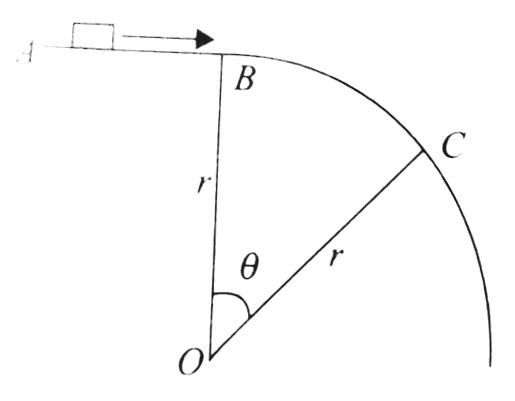
A small block slides with velocity v0=0....


A small block slides with velocity `v_0=0.5sqrt(gr)` on the horizontal frictiohnless surface as shown in the fig. the block leaves the surface at point C. The angle `theta` in the figure is:

A

less than `mu`

B

greater than `mu`

C

equal to `mu`

D

not dependent on `mu`

Text Solution

Verified by Experts

The correct Answer is:

B
Promotional Banner

Similar Questions

Explore conceptually related problems

A small block slides with velocity 0.5sqrt(gr) on the horizontal frictionless surface as shown in the figure. The block leaves the surface at point C . Calculate angle theta in the figure.

A spool is pulled at an angle theta with the horizontal on a rough horizontal surface as shown in the figure. If the spool remains at rest, the angle theta is equal to

A block of mass M rests on a rough horizontal surface as shown. Coefficient of friction between the block and the surface is mu . A force F=mg acting at angle theta with the vertical side of the block pulls it. In which of the following cases the block can be pulled along the surface?

A small block of mass m has speed sqrt(gR) /2 at the top most point of a fixed hemisphere of radius R as shown in figure. The angle theta , when block loses the contact with the hemisphere is

A block of mass m moving with velocity v_(0) on a smooth horizontal surface hits the spring of constant k as shown. The maximum compression in spring is

A small block of mass M moves on a frictionless surface of an inclined plane, as shown in the figure. The angle of the incline suddenly changes from 60^(@) to 30^(@) at point B . The block is many at rest at A . Assume that collisions between the block id the incline are totally inelastic. The speed of the block at point C , immediately before it leaves the second incline

Two blocks A and B are connected to each other by a string and a spring, the string passes over a frictionless pulley as shown in the figure. Block B slides over the horizontal top surface of a stationary block C and the block A slides along the vertical side of C, both with the same uniform speed. The coefficient of friction between the surfaces of blocks is 0.2. Force constant of the spring is 1960 newtons/m. If mass of block A is 2 kg. The mass of block B and the energy stored in the spring are _____ kg and _____ J.

Two blocks A and B are connected to each other by a string and a spring , the string passes over a frictionless pulley as shown in the figure. Block B slides over the horizontal top surface of a stationary block C and the block A slides along the vertical side of C , both with the same uniform speed. The coefficient of friction between the surface and blocks is 0.5, K = 2000 N//m . If mass of A is 2 kg calculate mass of B . .

Assuming all the surfaces to be frictionless accelration of the block c shown in the figure is

A block of mass m is placed at rest on a horizontal rough surface with angle of friction phi . The block is pulled with a force F at an angle theta with the horizontal. The minimum value of F required to move the block is
