Home
Class 12
PHYSICS
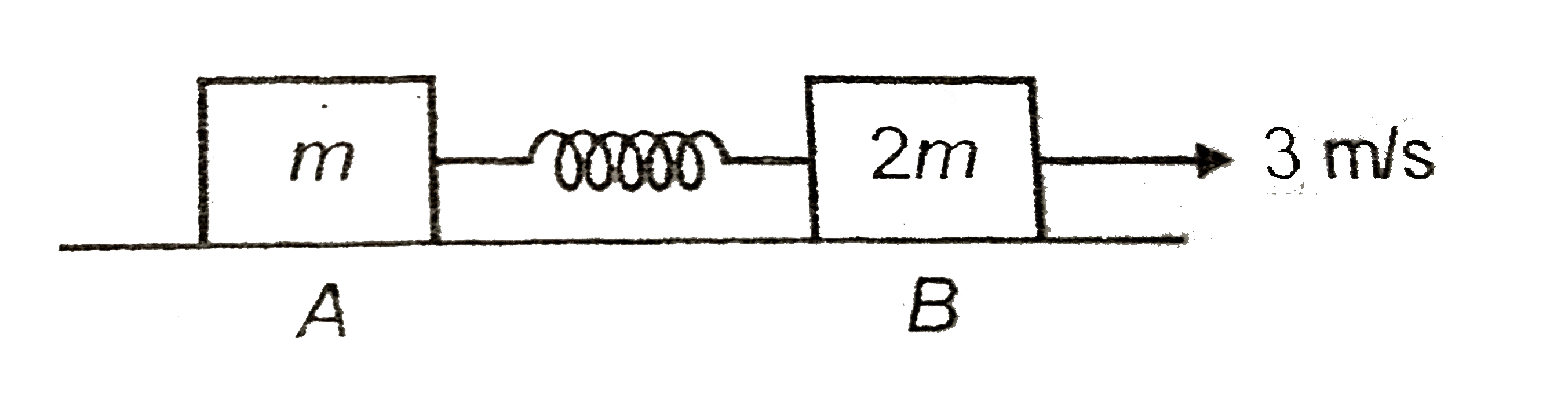
Two blocks A and B of masses m and 2m ar...

Two blocks `A` and `B` of masses `m` and `2m` are placed on a smooth horizontal surface. Block `B` is given a speed of `3m//s`. Find
`(i)` The maximum speed of `A`
`(ii)` The minimum speed of `B`.

A

`2 ms^(-2), 2 ms^(-2)`

B

`2 ms^(-2), 1 ms^(-2)`

C

`3 ms^(-2), 1 ms^(-2)`

D

`4 ms^(-2), 1 ms^(-2)`

Text Solution

Verified by Experts

The correct Answer is:

A
Promotional Banner

Similar Questions

Explore conceptually related problems

Two blocks A and B of mass 16kg and 64kg are placed on a smooth horizontal surface. Blocks are connected by a spring of spring constant 100 N//m . Find the ratio of maximum speed of block A to maximum speed of block B .

Two particles A and B of masses 2kg and 3kg moving on a smooth horizontal surface with speed 1m//s and 2m//s collides perfectly inelastically, then

Two balls A & B of mass m_(1) and m_(2) are kept on a horizontal smooth surface. A is given a velocity towards B so that they perform head on collision

Two blocks A and B of masses m and M are attached with ideal string and pulley, and placed on smooth horizontal surface. Force F is applied horizontally as shown in figure. Find the ratio of the acceleration of A to that of B.

Two blocks A and B each of mass m are placed on a smooth horizontal surface. Two horizontal force F and 2F are applied on blocks A and B, respectively, as shown in fig. Block A does not slide on block B. Then then the normal reaction acting between the two blocks is (assume no friction between the blocks)

Two blocks A and B each of mass m are placed on a smooth horizontal surface. Two horizontal force F and 2F are applied on blocks A and B, respectively, as shown in fig. Block A does not slide on block B. Then then the normal reaction acting between the two blocks is (assume no friction between the blocks)

Two blocks A and B each of mass m are placed on a smooth horizontal surface. Two horizontal force F and 2F are applied on blocks A and B, respectively, as shown in fig. Block A does not slide on block B. Then then the normal reaction acting between the two blocks is (assume no friction between the blocks)

Two blocks A and B each of mass m are placed on a smooth horizontal surface. Two horizontal force F and 2F are applied on blocks A and B, respectively, as shown in fig. Block A does not slide on block B. Then then the normal reaction acting between the two blocks is (assume no friction between the blocks)

Two blocks of mass m and 2m are kept in contact on a smooth horizontal surface. A horizontal pushing force F is applied on mass 2m in case I and on mass m in case II. Then the ratio of normal reaction between the blocks in case I to that in case II is :

A block of mass m is placed at rest on a smooth wedge of mass M placed at rest on a smooth horizontal surface. As the system is released
