Home
Class 12
PHYSICS
One end of a 60m long rope of mass 1.8 k...

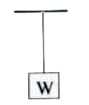
One end of a 60m long rope of mass 1.8 kg is tied to a rigid horizontal support held high above the ground. The rope hangs vertically and kept taut by a weight 'W' suspended at its lower end. A person jerks the lower end of the rope sideways in a sinusoidal manner and a transverse wave of frequency 2 Hz and amplitude 10cm passes along the rope such that there are 2 cycles of the wave in the total length of the rope. Neglecting the weight of the rope as compared to the suspended weight W and with g = 10m/s2, answer the following questions. `(S = 75 xx 10^(-4) m^2)`

In the questions above, weight of the rope has been neglected as compared to the suspended weight. However, if we also account for the weight of the rope. the speed of the wave at the top of the rope will be

A

3.2w

B

2.25w

C

1.4w

D

0.75w

Text Solution

Verified by Experts

The correct Answer is:

A
Promotional Banner

Topper's Solved these Questions

  • WAVE MOTION

    AAKASH SERIES|Exercise PRACTICE SET (EXERCISE-II (LEVEL-II(ADVANCED) INTEGER TYPE QUESTIONS))|2 Videos
  • WAVE MOTION

    AAKASH SERIES|Exercise PRACTICE SET (EXERCISE-III (LEVEL-I(MAIN) STRAIGHT OBJECTIVE TYPE QUESTIONS))|10 Videos
  • WAVE MOTION

    AAKASH SERIES|Exercise PRACTICE SET (EXERCISE-II (LEVEL-II(ADVANCED) MORE THAN ONE CORRECT ANSWER TYPE QUESTIONS))|4 Videos
  • UNITS AND MEASUREMENTS

    AAKASH SERIES|Exercise EXERCISE -3|66 Videos
  • WAVE MOTION AND SOUND

    AAKASH SERIES|Exercise PROBLEMS (LEVEL - II)|97 Videos

Similar Questions

Explore conceptually related problems

One end of a long rope is tied to a fixed vertical pole. The rope is stretched horizontally with a tension 8 N. Let us consider the length of the rope to be along X-axis. A sample harmonic oscillator at x = 0 generates a transverse wave of frequency 100 Hz and amplitude 2 cm along the rope. Mass of a unit length of the rope is 20 gm/m. Ignoring the effect of gravity, answer the following questions Wavelength of the wave is

One end of a long rope is tied to a fixed vertical pole. The rope is stretched horizontally with a tension 8 N . Let us cinsider the length of the rope to be along x-axis. A simple harmonic oscillator at x=0 generates a transverse wave of frequency 100 Hz and amplitude 2 cm along the rope. Mass of a unit length of the rope is 20 g//m . ignoring the effect of gravity, answer the following quetions. maximum magnitude of transverse acceleration of any point on the rope will be nearly

Find the velocity of the hanging block if the velocities of the free ends of the rope are as indicated in the figure.

One end of a long rope is tied to a fixed vertical pole. The rope is stretched horizontally with a tension 8 N . Let us cinsider the length of the rope to be along x-axis. A simple harmonic oscillator at x=0 generates a transverse wave of frequency 100 Hz and amplitude 2 cm along the rope. Mass of a unit length of the rope is 20 g//m . ignoring the effect of gravity, answer the following quetions. Tension in the given rope remaining the same, if a simple harmonic oscillator of frequency 200 Hz is used instead of the earlier oscillator of frequency 100 Hz

A pulse is generated at lower end to a hanging rope of uniform density and length L. The speed of the pulse when it reaches the mid point of rope is

A thick uniform rope of length L is hanging from a rigid support. A transverse wave of wavelength lamda_(0) is set up in the middle of the rope. The wavelength of the wave as it reaches the top most point is

A heavy uniform rope is held vertically by clamping it to a rigid support at the upper end. A wave of a certain frequency is set up at the lower end. The wave will

A heavy rope is suspended from a rigid support A wave pulse is set up at the lower end, then

A heavy rope is suspended from a rigid support A wave pulse is set up at the lower end, then

A uniform rope of mass 0.1 kg and length 2.45 m hangs from a ceiling. (a) Find the speed of transverse wave in the rope at a point 0.5 m distant from the lower end. (b) Calculate the time taken by a transverse wave to travel the full length of the rope.
