Home
Class 12
PHYSICS
Four similar prisms of angle of prism ar...

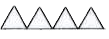
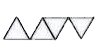
Four similar prisms of angle of prism are arranged. Which of the following arrangements give no net angular deviation?

A

B

C

D

Text Solution

AI Generated Solution

The correct Answer is:

To solve the problem of determining which arrangement of four similar prisms results in no net angular deviation, we can follow these steps: ### Step 1: Understand the Concept of Angular Deviation The angular deviation (δ) produced by a prism is the angle by which light is deviated from its original path when it passes through the prism. For a single prism, the deviation can be calculated using the formula: \[ \delta = (n - 1)A \] where \( n \) is the refractive index of the prism material and \( A \) is the angle of the prism. ### Step 2: Analyze the Arrangements We need to evaluate the four arrangements of prisms provided in the question. The goal is to find an arrangement where the total deviation (sum of deviations from all prisms) equals zero. ### Step 3: Set Up the Condition for No Net Deviation For no net angular deviation, the sum of the deviations from the prisms must equal zero: \[ \delta_1 + \delta_2 + \delta_3 + \delta_4 = 0 \] This can also be expressed as: \[ \delta_1 + \delta_2 = -(\delta_3 + \delta_4) \] This means that the deviations caused by the first two prisms must be equal in magnitude and opposite in direction to the deviations caused by the last two prisms. ### Step 4: Evaluate Each Arrangement Let’s consider each arrangement (A, B, C, D) and analyze the deviations: - **Arrangement A**: All prisms arranged in the same direction. This will result in a cumulative deviation and will not yield zero net deviation. - **Arrangement B**: The first two prisms cause a deviation in one direction, while the last two prisms cause an equal deviation in the opposite direction. This arrangement satisfies the condition for no net deviation. - **Arrangement C**: Similar to Arrangement A, all prisms in the same direction, leading to a net deviation. - **Arrangement D**: The arrangement might have prisms that do not cancel out the deviations properly, resulting in a net deviation. ### Step 5: Conclusion After analyzing the arrangements, we find that **Arrangement B** is the only configuration that results in no net angular deviation. ### Final Answer The arrangement that gives no net angular deviation is **Arrangement B**. ---
Promotional Banner

Topper's Solved these Questions

  • GEOMETRICAL OPTICS

    AAKASH SERIES|Exercise LECTURE SHEET (EXERCISE II LEVEL -II (ADVANCED) MORE THAN ONE CORRECT TYPE QUESTIONS)|7 Videos
  • GEOMETRICAL OPTICS

    AAKASH SERIES|Exercise LECTURE SHEET (EXERCISE II LEVEL -II (ADVANCED) LINKED COMPREHENSION TYPE QUESTIONS)|9 Videos
  • GEOMETRICAL OPTICS

    AAKASH SERIES|Exercise LECTURE SHEET (EXERCISE II LEVEL -I (MAIN) STRAIGHT OBJECTIVE TYPE QUESTIONS)|17 Videos
  • ELEMENTS OF VECTORS

    AAKASH SERIES|Exercise QUESTIONS FOR DESCRIPTIVE ANSWERS|10 Videos
  • LAWS OF MOTION

    AAKASH SERIES|Exercise PRACTICE EXERCISE|106 Videos

Similar Questions

Explore conceptually related problems

In a thin prism of glass (refractive index 1.5), which of the following relations between the angle of minimum deviations delta_(m) and angle of prism r will be correct?

A ray of light is incident on a prism ABC of mu = sqrt(3) as shown in Fig. Find the angle of incidence for which the deviation of light by the prism ABC is minimum. By what angle should the second prism be rotated so that final ray suffers net minimum deviation ?

(a) Plot a graph for angle of deviation as a function of angle of incidence for a triangular prism. (b) Derive the relation for the refractive index of the prism in terms of the angle of minimum deviation and angle of prism.

(a) Define the following when refraction takes place through an equilateral glass prism (i) angle of incidence (ii) prism (iii) refracting angle of prism (iv) angle of emergence (v) angle of deviation (b) How are angle of incidence, angle of prism, angle of emergence and angle of deviation related to each other?

The refracting angle of a prism is A and refractive index of the material of prism is cot(A//2) . The angle of minimum deviation will be

The refracting angle of a prism is A and refractive index of the material of prism is cot(A//2) . The angle of minimum deviation will be

The refracting angle of a prism is A and refractive index of the material of prism is cot(A//2) . The angle of minimum deviation will be

For a small angled prism, angle of minimum deviation (delta) varies with the refractive index of the prism as shown in the graph

The refracting angle of a prism is A and refractive index of the material of prism is cot(A//2) . The angle of minimum deviation will be

In determining the angle of minimum deviation for a given prism, a graph is plotted between the angle of incidence (j) and the angle of deviation (delta) . Which of the following graphs will correctly

AAKASH SERIES-GEOMETRICAL OPTICS-LECTURE SHEET (EXERCISE II LEVEL -II (ADVANCED) STRAIGHT OBJECTIVE TYPE QUESTIONS)
  1. The apparent depth of an object O from AB is

    Text Solution

    |

  2. A point source S is placed at the bottom of different layers as shown ...

    Text Solution

    |

  3. A person looking through a telescope focuses lens at a point on the ed...

    Text Solution

    |

  4. x-y plane separates two media, zge0 contains a medium of refractive i...

    Text Solution

    |

  5. A body weighs w Newton on the surface of the earth. Its weight at a he...

    Text Solution

    |

  6. The graph between sine of angle of refraction (sin r) in medium 2 and ...

    Text Solution

    |

  7. A cubic container is filled with a liquid whose refractive index incre...

    Text Solution

    |

  8. Four similar prisms of angle of prism are arranged. Which of the follo...

    Text Solution

    |

  9. A light ray is incident upon a prism in minimum deviation position and...

    Text Solution

    |

  10. A ray of light strikes a plane mirror at an angle of incidence 45^@ as...

    Text Solution

    |

  11. The xz plane separates two media A and B with refractive indices mu(1)...

    Text Solution

    |

  12. A microscope is focussed on a point object, and then its objective is ...

    Text Solution

    |

  13. It is found that electromagnetic signals sent inside glass sphere from...

    Text Solution

    |

  14. A light ray is incident on a transparent slab of refractive index mu=s...

    Text Solution

    |

  15. The time required for the light to go from A to B, when a ray of lilgh...

    Text Solution

    |

  16. The apparent depth of water in cylindrical water tank of diameter 2R c...

    Text Solution

    |

  17. A ray of light travels from a medium of refractive index mu to air. It...

    Text Solution

    |

  18. A man of height 1.47 m stands on a straight road on a hot day. The ver...

    Text Solution

    |

  19. A glass slab of thickness 3 cm and refractive index 3/2 is placed on i...

    Text Solution

    |

  20. Solar rays are incident at 45^(@) on the surface of water (mu=4//3). T...

    Text Solution

    |
