Home
Class 12
PHYSICS
A light ray is incident at an angle of i...

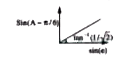
A light ray is incident at an angle of incedence `(pi//4)`. The graph of `sin(A-pi//6)` versus sin e is shown in fig. The minimum angle of devation corresponds to a prism with angle (e=angle of emergence )

A

`90^(@)`

B

`60^(@)`

C

`45^(@)`

D

`30^(@)`

Text Solution

Verified by Experts

The correct Answer is:

B
Promotional Banner

Topper's Solved these Questions

  • GEOMETRICAL OPTICS

    AAKASH SERIES|Exercise ADDITIONAL PRACTICE EXERCISE -I (LEVEL-II LECTURE SHEET (ADVANCED) MORE THAN ONE CORRECT TYPE QUESTIONS)|3 Videos
  • GEOMETRICAL OPTICS

    AAKASH SERIES|Exercise ADDITIONAL PRACTICE EXERCISE -I (LEVEL-II LECTURE SHEET (ADVANCED) LINKED COMPREHENSION TYPE QUESTIONS)|8 Videos
  • GEOMETRICAL OPTICS

    AAKASH SERIES|Exercise ADDITIONAL PRACTICE EXERCISE -I (LEVEL-I(MAIN) STRAIGHT OBJECTIVE TYPE QUESTIONS)|21 Videos
  • ELEMENTS OF VECTORS

    AAKASH SERIES|Exercise QUESTIONS FOR DESCRIPTIVE ANSWERS|10 Videos
  • LAWS OF MOTION

    AAKASH SERIES|Exercise PRACTICE EXERCISE|106 Videos

Similar Questions

Explore conceptually related problems

A light ray is incident on a glass sphere at an angle of incidence 60^(@) as shown. Find the angles r, r^(1) , e and the total deviation after two refractions.

A ray of light incident at an angle of incidence 'I' passes through an equilateral glass prism such that the refracted ray inside the prism is parallel to its base and emerges from the prism at an angle of emergence 'e'. How is the angle of emergence 'e' related to the angle of incidence 'i' ?

A ray of light incident at an angle of incidence 'I' passes through an equilateral glass prism such that the refracted ray inside the prism is parallel to its base and emerges from the prism at an angle of emergence 'e'. What can you say about the value of the angle of deviation in such a situation ?

A ray of light incident at an angle of incidence 48^(@) on a prism of refracting angle 60^(@) suffers minimum deviation. Calculate the angle of minimum deviation.

A light ray of yellow colour is incident on an equilateral glass prism at an angle of incidence equal to 48^(@) and suffers minimum deviation by an angle of 36^(@) . (i) What will be the angle of emergence ? (ii) If the angle of incidence is changed to (a) 30^(@) (b) 60^(@) , state in each case whether the angle of deviatioin will be equal to, less than or more than 36^(@) . ?

(a) Define the following when refraction takes place through an equilateral glass prism (i) angle of incidence (ii) prism (iii) refracting angle of prism (iv) angle of emergence (v) angle of deviation (b) How are angle of incidence, angle of prism, angle of emergence and angle of deviation related to each other?

A ray incident at an angle 53^(@) on a prism emerges at an angle 37^(@) as shown. If the angle of incidence is made 50^(@) , which of the following is a possible value of the angle of emergence?

Show that for a light ray incident at an angle i on getting reflected the angle of deviation is delta=pi-2i or pi +2i .

For a prism kept in air, it is found that for an angle of incidence 60^(@) , the angle of refraction 'A', angle of deviation delta , and angle of emergence 'e' become equal. The minimum angle of incidence of a ray that will be transmitted through the prism is

A ray of light is incident on one of the faces of the angle prism with an angle 40^(@) with the surface. The angle of the prism is 60^(@) . The emergent ray is deviated through an angle 38^(@) . The angle of emergence is

AAKASH SERIES-GEOMETRICAL OPTICS-ADDITIONAL PRACTICE EXERCISE -I (LEVEL-II LECTURE SHEET (ADVANCED) STRAIGHT OBJECTIVE TYPE QUESTIONS)
  1. A person looking through a telescope focuses lens at a point on the ed...

    Text Solution

    |

  2. A rod of glass (mu=1.5) and of square cross section is bent into the s...

    Text Solution

    |

  3. A light ray is incident at an angle of incedence (pi//4). The graph of...

    Text Solution

    |

  4. Light is incident from glass (mu = 1.50) to water (mu = 1.33) find th...

    Text Solution

    |

  5. A ray of light is incident at an angle of 75^(@) into a medium having ...

    Text Solution

    |

  6. A beam of parallel rays of width b cm propagates in glass at an angle ...

    Text Solution

    |

  7. A small object of height 0.5 cm is placed in front of a convex surface...

    Text Solution

    |

  8. A ball is kept at a height h above the surface of a heavy transparent ...

    Text Solution

    |

  9. A ring of radius 1cm is placed 1m in front of a spherical glass ball...

    Text Solution

    |

  10. The radii of curvature of two spherical surfaces of a concave convex l...

    Text Solution

    |

  11. A light ray travelling parallel to the principal axis of a convex lens...

    Text Solution

    |

  12. Twot thin lenses when placed in contact, then the power of combination...

    Text Solution

    |

  13. A convex lens is placed some where between an object and a screen whic...

    Text Solution

    |

  14. A point object moves along the principal axis of a convex lens of foca...

    Text Solution

    |

  15. A thin plano-convex lens of focal length f is split into two halves. O...

    Text Solution

    |

  16. A converging lens L(1) of focal length 20 cm is separated by 8 cm from...

    Text Solution

    |

  17. A point object is placed at a distance of 20 cm from a thin plano-conc...

    Text Solution

    |

  18. A convex lens of focal length f and a plane mirror are y distance apar...

    Text Solution

    |

  19. A point object O is placed at a distance of 0.3m from a convex lens (f...

    Text Solution

    |

  20. A small object stuck on the surface of a glass sphere (n=1.5) is viewe...

    Text Solution

    |
