Home
Class 12
PHYSICS
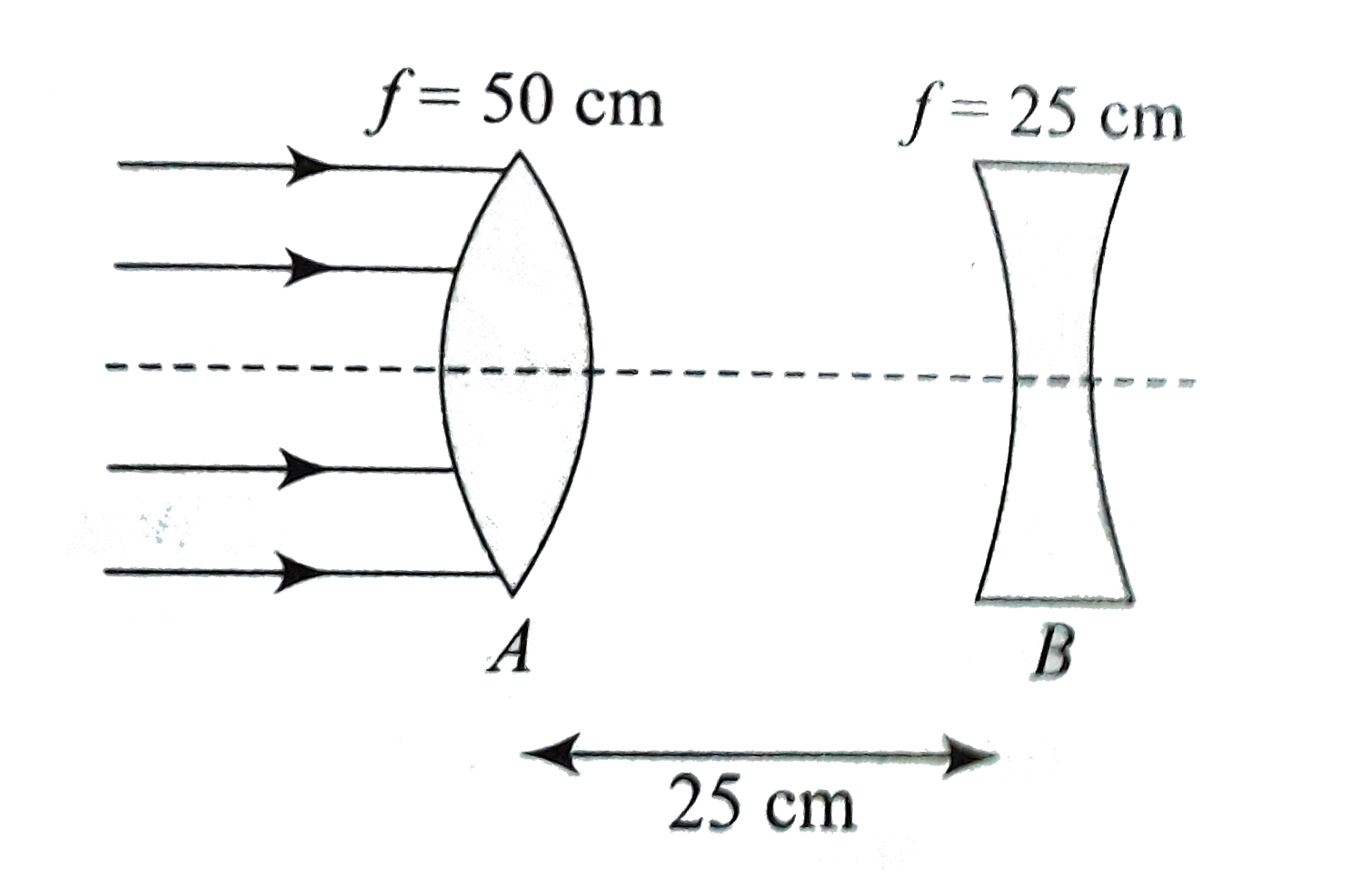
Two lenses shown in figure. Are illumina...

Two lenses shown in figure. Are illuminated by a beam of parallel light from the left. Lens B is then moved slowly toward lens A. the beam emerging from lens B is

A

always diverging

B

initially parallel and then diverging

C

always parallel

D

initially converging and then parallel

Text Solution

Verified by Experts

The correct Answer is:

B
Promotional Banner

Topper's Solved these Questions

  • GEOMETRICAL OPTICS

    AAKASH SERIES|Exercise PRACTICE SHEET (ADVANCED) (MORE THAN ONE CORRECT TYPE QUESTIOS)|4 Videos
  • GEOMETRICAL OPTICS

    AAKASH SERIES|Exercise PRACTICE SHEET (ADVANCED) (LINKED COMPREHENSION CORRECT TYPE QUESTIOS)|7 Videos
  • GEOMETRICAL OPTICS

    AAKASH SERIES|Exercise ADDITIONAL PRACTICE EXERCISE -I (LEVEL-II LECTURE SHEET (ADVANCED) INTEGER TYPE QUESTIONS)|4 Videos
  • ELEMENTS OF VECTORS

    AAKASH SERIES|Exercise QUESTIONS FOR DESCRIPTIVE ANSWERS|10 Videos
  • LAWS OF MOTION

    AAKASH SERIES|Exercise PRACTICE EXERCISE|106 Videos

Similar Questions

Explore conceptually related problems

A thin convex lens (L_(1)) of focal length 80 cm and a thin concave lens (L_(2)) of focal length f are kept co-axially, 20 cm apart as shown in figure below. When a narrow and parallel beam of light is incident on the conver lens, beam emerging from the concave lens is also a parallel beam. Find f.

Two thin lenses are placed 5cm apart along the same axis and illuminted with a beam of light parallel to that axis. The first lens in the path of the beam is a converging lens of focal length 10cm whereas the second is a diverging lens of focal length 5cm. If the second lens if now moved toward the first, the emergent light

In the arrangement shown in figure, O is the object. An observer is to the left of convex lens and looking towards lens. The observer will see an image

A convex lens of focal length 1.0m and a concave lens of focal length 0.25m are 0.75m apart. A parallel beam of light is incident on the convex lens. The beam emerging after refraction from both lenses is

A convex lens forms an image of an object on a screen 30 cm from the lens. When the lens is moved 90 cm towards the object, then the image is again formed on the screen. Then, the focal length of the lens is

A parallel beam of light falls successively on a thin convex lens of focal length 40 cm and then ono a thin convex lens of focal length 10cm as shown in figure. In figure, the second lens is an equi-concave lens of focal length 10cm and made of a material of refractive index 1.5. In both the cases, the second lens has an aperture equal to 1cm. Q. Compare the area illuminated by the beam of light on the screen, which passes through the second lens in the two cases. The ratio (A_(2)//A_(1)) will be

A bi-convex lens is cut from the middle as shown in figure. Refractive index of material of lens is (3)/(2) . Now lens-1 (as shown in figure) is immersed in a liquid of refractive index mu_(0) . By doing so it is observed that its focal length becomes equal to lens-2. What is the value of mu_(0) ?

A symmetrical bioconcave lens having radius of curvature R is made up to two different materials as shown in figure. A parallel beam of light passing through the lens appear to diverge from two different points. Find the distance between them.

A lens is made of three thin different mediums. Radius of curvature and refractive index of each medium is shown iin Figure., Surface AB is straight. An object is placed at some distance from the lens by which a real image is formed on the screen placed at a distance of 10cm from the lens. Find the distance of the object from the lens.

A convex lens of focal length 20cm and a concave lens of focal length f are mounted coaxially 5cm apart. Parallel beam of light incident on the convex lens emerges from the concave lens as a parallel beam. Then, f in cm is

AAKASH SERIES-GEOMETRICAL OPTICS-PRACTICE SHEET (ADVANCED) (STRAIGHT OBJECTIVE TYPE QUESTIOS)
  1. A ray of light travelling in glass having refractive index (a)mu(g)=3/...

    Text Solution

    |

  2. A light ray is normally incident onone face of equilateral glass prism...

    Text Solution

    |

  3. Light ray is incident on a prism of angle A=60^(@) are refractive inde...

    Text Solution

    |

  4. The n transparent slabs of refractive index1.5 each having thickness 1...

    Text Solution

    |

  5. A glass sphere of diameter 50 cm and mu=1.5 has a small air bubble. Lo...

    Text Solution

    |

  6. A parallel beam falls on solid glass sphere of radius R and refractive...

    Text Solution

    |

  7. A transparent glass sphere of radius 10 cm and refractive index mu=1.5...

    Text Solution

    |

  8. A convex lens of focal length 20cm and another plano convex lens of fo...

    Text Solution

    |

  9. Find the focal length of the lens shown in Fig.

    Text Solution

    |

  10. Light is incident on the thin lens as shown in figure. The refractive ...

    Text Solution

    |

  11. When an object is placed 40cm from a diverging lens, its virtual image...

    Text Solution

    |

  12. The given lens is broken into four parts rearranged as shown. If the i...

    Text Solution

    |

  13. A thin converging lens is placed between as fixed object and a screen....

    Text Solution

    |

  14. A thin biconvex lens of refractive index 3//2 is placed on a horizonta...

    Text Solution

    |

  15. A convex lens is placed between an object and a screen which are at a ...

    Text Solution

    |

  16. The value of escape speed from the surface of earth is

    Text Solution

    |

  17. Two lenses shown in figure. Are illuminated by a beam of parallel ligh...

    Text Solution

    |

  18. A double convex lens forms a real image of an objectt on a screen whic...

    Text Solution

    |

  19. Choose the correct ray diagram of an equi convex lens which is cut as ...

    Text Solution

    |

  20. A biconvex thin lens of radius of curvature R is made up of variable r...

    Text Solution

    |
