Home
Class 12
MATHS
alpha,beta are the real roots of ax^(2) ...

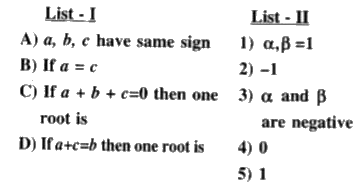
`alpha,beta` are the real roots of `ax^(2) + bx + c = 0` observe the following lists

then the correct matching is

A

`{:(A,B,C,D),(1,1,2,5):}`

B

`{:(A,B,C,D),(1,3,4,5):}`

C

`{:(A,B,C,D),(3,1,5,4):}`

D

`{:(A,B,C,D),(3,1,5,2):}`

Text Solution

Verified by Experts

The correct Answer is:

D
Promotional Banner

Similar Questions

Explore conceptually related problems

The quadratic equation ax^(2) + bx + c = 0 has two roots then match the following lists. Find the correct match from List-I to List-II.

If alpha, beta are the roots of x^(2) + bx-c = 0 , then the equation whose roots are b and c is

If alpha, beta are the roots of ax^2 + bx + c = 0, the equation whose roots are 2 + alpha, 2 + beta is

If alpha, beta are the roots of ax^(2) + bx + c = 0 , then find the quadratic equation whose roots are alpha + beta, alpha beta .

If alpha , beta are the roots of ax ^2 + bx +c=0 then alpha ^5 beta ^8 + alpha^8 beta ^5=

If alpha,beta are the roots of the equation ax^2 + bx +c=0 such that beta < alpha < 0 , then the quadratic equation whose roots are |alpha|,|beta| is given by

If alpha, beta are the roots of ax^(2) + bx + c = 0 and alpha + h, beta + h are the roots of px^(2) + qx + r = 0 , then h =

If alpha, beta are the roots of x^(2) + bx + c = 0 and, alpha +h, beta+h are the roots of x^(2) + qx +r = 0 then h =

If alpha, beta are the roots of a x^2 + bx + c = 0 and k in R then the condition so that alpha < k < beta is :

If alpha, beta are the roots of the equation ax^(2) +2bx +c =0 and alpha +h, beta + h are the roots of the equation Ax^(2) +2Bx + C=0 then
