Home
Class 12
PHYSICS
Two particles, 1 and 2 move with constan...

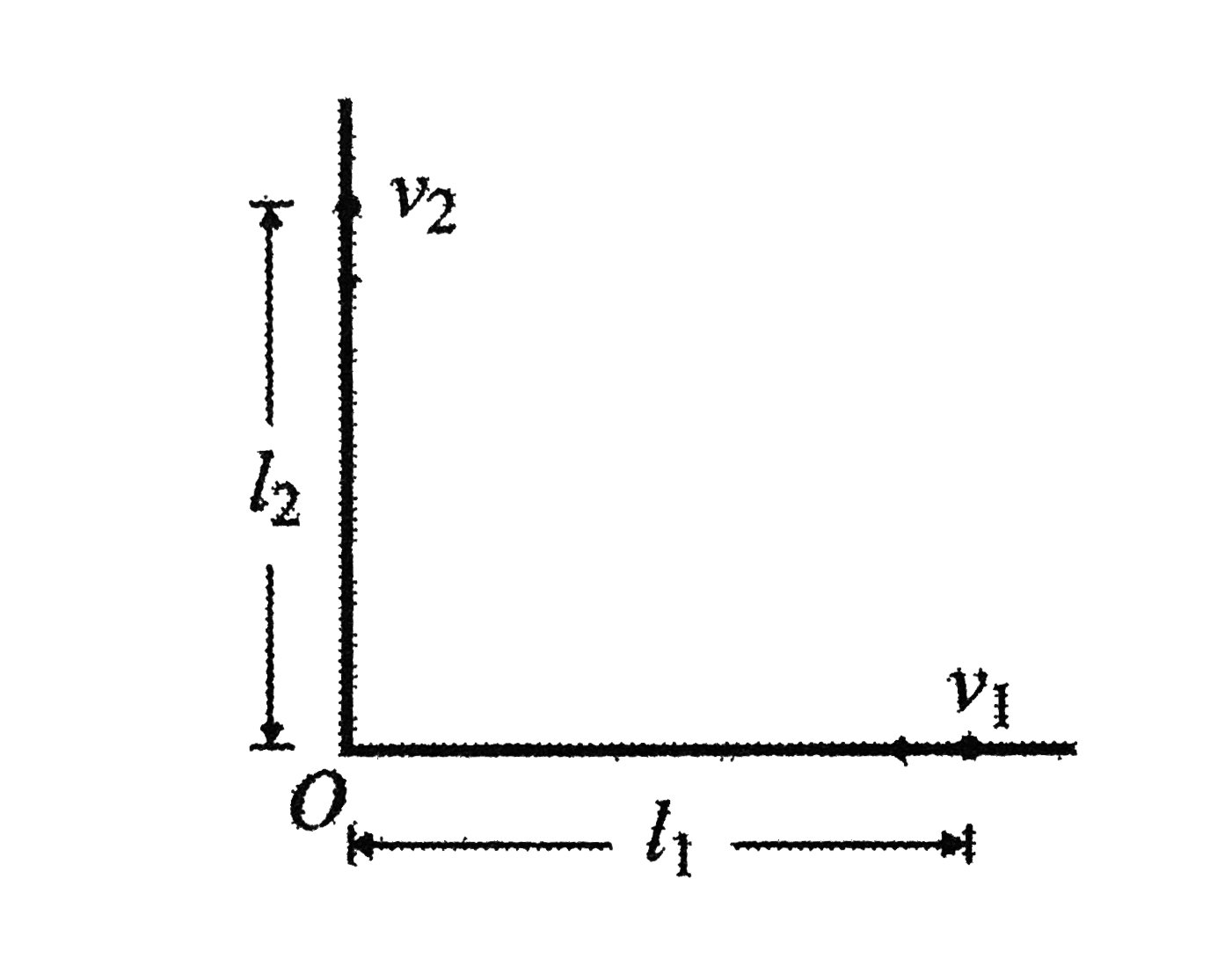
Two particles, 1 and 2 move with constant velocities `v_1` and `v_2` along two mutually perpendicular straight lines towards the intersection point O. At the moment `t=0` the particles were located at the distance `l_1` and `l_2` from the point O. How soon will the distance between the particles become the smallest? What is it equal to?

Text Solution

Verified by Experts
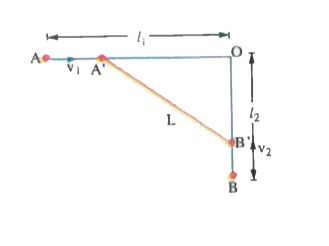
After time .t. ,the position of the point
A and B are `(l_(1)-v_(1)t)` and `(l_(2)-v_(2)t)`. Repectively.
The distance L.between the points A. and B. are
`L_(2)=(l_(1)-v_(1)t)^(2)+(l_(2)-v_(2)t)^(2)`
From minimum value of `L(dL)/(dt)=0`
`(v_(1)^(2)+v_(2)^(2))t=l_(1)v_(1)+l_(2)v_(2)` or `t=(l_(1)v_(1)+l_(2)v_(2))/(v_(1)^(2)+v_(2)^(2))`
Putting the value of t in equation (1)
`L_(min)=(|1_(1)v_(2)+l_(2)v_(1)|)/(sqrt(v_(1)^(2)+v_(2)^(2)))`
Promotional Banner

Topper's Solved these Questions

  • MOTION IN A STRAIGHT LINE

    AAKASH SERIES|Exercise Numerical exercise(LEVEL-1)|22 Videos
  • MOTION IN A STRAIGHT LINE

    AAKASH SERIES|Exercise Numerical exercise(LEVEL-2)|29 Videos
  • MOTION IN A STRAIGHT LINE

    AAKASH SERIES|Exercise PRACTICE EXERCISE|58 Videos
  • MOTION IN A PLANE

    AAKASH SERIES|Exercise QUESTION FOR DESCRIPTIVE ANSWER|7 Videos
  • MOVING CHARGES AND MAGNETISM

    AAKASH SERIES|Exercise EXERCISE-III|49 Videos

Similar Questions

Explore conceptually related problems

Two particles A and B move with constant velocity vec(v_1) and vec(v_2) along two mutually perpendicular straight lines towards intersection point O as shown in figure, At moment t = 0 particles were located at distance l_1 and l_2 respectively from O. Then minimu distance between the particles and time taken are respectively

Two ships, V and W, move with constant velocities 2 ms^(-1) and 4 ms^(-1) along two mutually perpendicular straight tracks toward the intersection point O. At the moment t=0 , the ships V & W were located at distances 100 m and 200 m respectively from the point O. The distance between them will be shortest at t= ........

Two ships, V and W, move with constant velocities 2 ms^(-1) and 4 ms^(-1) along two mutually perpendicular straight tracks toward the intersection point O. At the moment t=0 , the ships V & W were located at distances 100 m and 200 m respectively from the point O. The distance between them will be shortest at t= ........

Two particles, 1 and 2, move with constant velocities v_1 and v_2 . At the initial moment their radius vectors are equal to r_1 and r_2 . How must these four vectors be interrelated for the particles to collide?

Two particles move with constant velocities towards point O along straight lines in a plane as shown. The shortest distance A and B is

Two particles 1 and 2 move with velocities vec v_1 and vec v_2 making the angles theta_1 and theta_2 with the line joining them, respectively. Find angular velocity of relative to 1 . .

A particle move with velocity v_(1) for time t_(1) and v_(2) for time t_(2) along a straight line. The magntidue of its average acceleration is

Two particles are moving along two long straight lines, in the same plane with same speed equal to 20 cm//s. The angle between the two linse is 60^@ and their intersection point isO. At a certain moment, the two particles are located at distances 3m and 4m from O and are moving twowards O. Subsequently, the shortest distance between them will be

Two particles are moving with velocities v_(1) and v_2 . Their relative velocity is the maximum, when the angle between their velocities is

Two particles move in a uniform gravitational field with an acceleration g. At the initial moment the particles were located over a tower at one point and moved with velocities v_1 = 3m//s and v_2= 4m//s horizontally in opposite directions. Find the distance between the particles at the moment when their velocity vectors become mutually perpendicular.

AAKASH SERIES-MOTION IN A STRAIGHT LINE -problems
  1. A body when projected vertically up, covers a total distance D during ...

    Text Solution

    |

  2. Drop of water fall at regular intervals from roof of a building of hei...

    Text Solution

    |

  3. A ball thrown up from the ground reaches a maximum height of 20 m Find...

    Text Solution

    |

  4. A particle is projected vertically upwards. Prove that it will be at t...

    Text Solution

    |

  5. An object falls from a bridge which is 45 m above the water. It falls ...

    Text Solution

    |

  6. On a frictionless horizontal surface , assumed to be the x-y plane ,...

    Text Solution

    |

  7. Two particles 1 and 2 are allowed to descend on two frictionless chord...

    Text Solution

    |

  8. Ball A dropped from the top of a building. A the same instant ball B i...

    Text Solution

    |

  9. A helicopter is ascending vertically with a speed of 8.0 "ms"^(-1). At...

    Text Solution

    |

  10. A stone is thrown vertically upward with a speed of 10.0 ms^(-1) from ...

    Text Solution

    |

  11. A body took 't' sec. to come down from top of tower.Find the time take...

    Text Solution

    |

  12. Fig. 2.33 shows displacement-time graph of two vehicles A and B moving...

    Text Solution

    |

  13. Figure a represents the speed-time graph for a particle .Find the dist...

    Text Solution

    |

  14. The acceleration time graph of a particle moving along a straight lin...

    Text Solution

    |

  15. Velocity and acceleration of a particle at time t=0are u=(2 hati+3 hat...

    Text Solution

    |

  16. Velocity-time graph for the motion of a certain body is shown in Fig. ...

    Text Solution

    |

  17. The acceleration-displacement graph of a particle moving in a straight...

    Text Solution

    |

  18. Two particles, 1 and 2 move with constant velocities v1 and v2 along t...

    Text Solution

    |

  19. Acceleration of a particle at any time t is veca=(2thati+3t^(2)hatj)m/...

    Text Solution

    |

  20. Acceleration of a particle at any time t is veca=(2thati+3t^(2)hatj)m/...

    Text Solution

    |

