Home
Class 12
PHYSICS
A particle moving along straight line ha...

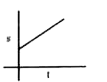
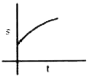
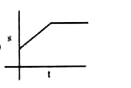
A particle moving along straight line has velocity `v = mu s` where s is in the displacement . If `s = s_0` then which of the following graph best represent s versus t

A

B

C

D

Text Solution

AI Generated Solution

The correct Answer is:

To solve the problem, we need to analyze the relationship between the velocity \( v \) and the displacement \( s \) given by the equation \( v = \mu s \). We will derive the expression for displacement \( s \) as a function of time \( t \) and then identify the appropriate graph that represents this relationship. ### Step-by-Step Solution: 1. **Understand the given relationship**: We are given that the velocity \( v \) of a particle is proportional to its displacement \( s \) such that: \[ v = \mu s \] where \( \mu \) is a constant. 2. **Relate velocity to displacement**: We know that velocity \( v \) can also be expressed as the rate of change of displacement with respect to time: \[ v = \frac{ds}{dt} \] Therefore, we can equate the two expressions for velocity: \[ \frac{ds}{dt} = \mu s \] 3. **Rearrange the equation**: We can rearrange this equation to separate variables: \[ \frac{ds}{s} = \mu dt \] 4. **Integrate both sides**: Now we will integrate both sides. The left side will be integrated with respect to \( s \) and the right side with respect to \( t \): \[ \int \frac{ds}{s} = \int \mu dt \] This gives us: \[ \ln |s| = \mu t + C \] where \( C \) is the constant of integration. 5. **Solve for the constant**: To find the constant \( C \), we use the initial condition. At \( t = 0 \), the displacement \( s = s_0 \): \[ \ln |s_0| = C \] 6. **Substitute back to find \( s \)**: Substituting \( C \) back into the equation, we have: \[ \ln |s| = \mu t + \ln |s_0| \] Exponentiating both sides gives: \[ |s| = e^{\mu t} \cdot |s_0| \] Thus, we can express \( s \) as: \[ s = s_0 e^{\mu t} \] 7. **Identify the graph**: The equation \( s = s_0 e^{\mu t} \) represents an exponential growth function. At \( t = 0 \), \( s \) equals \( s_0 \), and as \( t \) increases, \( s \) increases exponentially. The graph of \( s \) versus \( t \) will be an upward-curving exponential graph starting from the point \( (0, s_0) \). ### Conclusion: The graph that best represents \( s \) versus \( t \) is an exponential curve starting at \( s_0 \) when \( t = 0 \) and increasing as \( t \) increases.
Promotional Banner

Topper's Solved these Questions

  • APPENDICES (REVISION EXERCISE)

    AAKASH SERIES|Exercise MOTION IN A PLANE|87 Videos
  • APPENDICES (REVISION EXERCISE)

    AAKASH SERIES|Exercise LAW OF MOTION|128 Videos
  • APPENDICES (REVISION EXERCISE)

    AAKASH SERIES|Exercise LAW OF MOTION|128 Videos
  • APPENDICES ( REVISION EXERCISE )

    AAKASH SERIES|Exercise REVISION EXERCISE (MAGNETISM AND MATTER )|52 Videos
  • ATOMS

    AAKASH SERIES|Exercise PRACTICE EXERCISE|21 Videos

Similar Questions

Explore conceptually related problems

A particle moves along a straight line its velocity dipends on time as v=4t-t^(2) . Then for first 5 s :

An object starts at the origin in a straight line. Its velocity versus time graph is shown in the figure. Which one of the following choices best gives the proper intervals (s) of time for which the object is moving away from the origin?

A particle is moving on a straight line. Its velocity at time t is (8-2t)m//s . What is the total distance covered from t=0 to t=6s ?

The speed(v) of a particle moving along a straight line is given by v=(t^(2)+3t-4 where v is in m/s and t in seconds. Find time t at which the particle will momentarily come to rest.

A particle moving in a straight line has velocity-displacement equation as v = 5 sqrt(1 + s). Here v is in ms^-1 and s in metres. Select the correct alternative.

The velocity 'v' of a particle moving along straight line is given in terms of time t as v=3(t^(2)-t) where t is in seconds and v is in m//s . The displacement of aprticle from t=0 to t=2 seconds is :

The velocity 'v' of a particle moving along straight line is given in terms of time t as v=3(t^(2)-t) where t is in seconds and v is in m//s . The distance travelled by particle from t=0 to t=2 seconds is :

A particle moving along a straight line with uniform acceleration has velocities 7 m//s at A and 17 m//s at C. B is the mid point of AC. Then :-

If the velocity v of a particle moving along a straight line decreases linearly with its displacement from 20 m//s to a value approaching zero at s = 30 m, determine the acceleration of the particle when s = 15 m.

If the velocity v of particle moving along a straight line decreases linearly with its displacement s from 20 ms^(-1) to a value approaching zero at s = 30 m, then acceleration of the particle at v=10ms^(-1) is

AAKASH SERIES-APPENDICES (REVISION EXERCISE)-MOTION IN A STRAIGHT LINE
  1. A train takes t sec to perform a journey , if travel for t/n sec with ...

    Text Solution

    |

  2. On fogy day two drivers spot in front of each other when 80 m apart, t...

    Text Solution

    |

  3. A particle moving along straight line has velocity v = mu s where s is...

    Text Solution

    |

  4. A bird is tossing (flying to and fro) between two cars moving towards ...

    Text Solution

    |

  5. On a long horizontally moving belt (Fig.3.26), a child runs to and fro...

    Text Solution

    |

  6. A stone is dropped from a hill of height 180 m. Two seconds later anot...

    Text Solution

    |

  7. Water drops fall from the roof a building 20 m high at regular time in...

    Text Solution

    |

  8. A body is dropped from a height of 16 m. The body strikes the ground a...

    Text Solution

    |

  9. The distance travelled by a falling body in the last second of its mot...

    Text Solution

    |

  10. A ball dropped from a point P crosses a point Q in t seconds. The time...

    Text Solution

    |

  11. Two balls are dropped from the same height at two different places A a...

    Text Solution

    |

  12. A lead ball dropped into a lake from a diving board 5 m above the wate...

    Text Solution

    |

  13. A body P is thrown vertically up with velocity 30 ms^(-1) and another ...

    Text Solution

    |

  14. A boy sees a ball go up and then down through a window 2.45 m high. If...

    Text Solution

    |

  15. A particle is projected vertically up and another is let fall to meet ...

    Text Solution

    |

  16. A ball is projected from the bottom of a tower and is found to go abov...

    Text Solution

    |

  17. A stone is dropeed from a height of10 cm above the top of a window 80 ...

    Text Solution

    |

  18. If a stone dropped from the top of a tower travels half, of the height...

    Text Solution

    |

  19. A particle starts from rest with uniform acceleration a. Its velocity...

    Text Solution

    |

  20. A smooth wedge of mass M is pushed with an acceleration a=gtantheta an...

    Text Solution

    |
