Home
Class 12
PHYSICS
A B C D is a parallelogram and E\ a n d\...

`A B C D` is a parallelogram and `E\ a n d\ F` are the centroids of triangles `A B D\ a n d\ B C D` respectively, then `E F=`
(a)`A E`
(b) `B E`
(c) `C E`
(d) `D E`

Text Solution

Verified by Experts
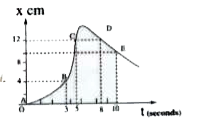

(a) As the particle moves from A to E, is the initial point and E is the final point.
The slope of the line drawn from A to E
i.e., `(Deltax)/(Deltat)` gives the average velocity during that interval of time.
The displacement `Deltax` is
`X_(E)-X_(A)`=10cm-0cm=+10cm
The time interval `Deltat_(EA)=t_(E)-t_(A)=10S`.
`therefore` During this interval average velocity
`barV=(Deltax)/(Deltat)=(+10cm)/(10S)=+1cms^(-1)`
(b)During the interval B to E. the displacement
`Deltax=x_(E)-x_(B)=10cm-4cm=6cm` and
`Deltat=t_(E)-t_(B)=10s-3s=7s.`
`Therefore` Average velocity `barV=(Deltax)/(Deltat)=(6cm)/(7s)`
=+0.857 `cms^(-1)=0.86cms^(-1)`
(c) During the interval C to E,the displacement
`Deltax=X_(E) -X_(c)=10cm0-12cm=2cm` nd
`Deltat=t_(E)-t_(c)=10s-5s=5s`
`therefore barv=(Deltax)/(Deltat)=(-2cm)/(5s)=-0.4 cms^(-1)`
(d)During the interval D to E,
the displacement
`Deltax=x_(E)-x_(D)=10cm-12cm=-2cm`
and the time interval
`Deltat=t-(E)-t_(D)`=10s-8s=2
`therefore barv=(v)=(Deltax)/(deltat)=(-2cm)/(2s)=-1cms^(-1)`
(e)During the interval C to D.the displacement
`Deltax-x_(D)-x_(c)`=12cm 12 cm=0
and the time interval
`Deltat=t_(D)-t_(c)`=8s-5s=3s
`therefore` The average velocity
`barv=(Deltax)/(Deltat)=(0m)/(3s)=0 ms^(-1)`
(The particle has reached the same position during these 3s.The average velocity is zero because the displacement is zero).
Promotional Banner

Similar Questions

Explore conceptually related problems

In Figure, A B C D is a parallelogram. E\ a n d\ F are the mid-points of the sides A B\ a n d\ C D respectively. Prove that the line segments A F\ a n d\ C E trisect (divide into three equal parts) the diagonal B D .

A B C D is a parallelogram, E\ a n d\ F are the mid-points of A B\ a n d\ C D respectively. G H is any line intersecting A D ,\ E F\ a n d\ B C at G ,\ P\ a n d\ H respectively. Prove that G P=P H

A B C D is a parallelogram and E is the mid-point of B C ,\ D E\ a n d\ A B when produced meet at F . Then A F=

In a parallelogram A B C D ,E ,F are any two points on the sides A B and B C respectively. Show that a r( /_\A D F)=a r( /_\D C E).

In a parallelogram A B C D ,E ,F are any two points on the sides A B and B C respectively. Show that a r(triangle A D F)=a r( triangle D C E) .

A B C D is a square E ,\ F ,\ G\ a n d\ H are points on A B ,\ B C ,\ C D\ a n d\ D A respectively, such that A E=B F=C G=D H . Prove that E F G H is square.

A B C D is a parallelogram. If A B is produced to E such that B E=A B . Prove that E D bisects B C .

A B C D is a trapezium with parallel sides A B=a\ a n d\ D C=bdot If E\ a n d\ F are mid-points of non-parallel sides A D\ a n d\ B C respectively, then the ratio of areas of quadrilaterals A B F E\ a n d\ E F C D is: a : b (b) (a+3b):(3a+b) (3a+b):(a+3b) (d) (3a+b):(3a+b)

A B C D is a square E ,\ F ,\ G\ a n d\ H are points on A B ,\ B C ,\ C D\ a n d\ D A respectively, such that A E=B F=C G=D Hdot Prove that E F G H is square.

A D\ a n d\ B E are respectively altitudes of A B C such that A E=B D . Prove that A D=B E .

