Home
Class 12
PHYSICS
A particle moving along straight line ha...

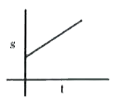
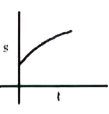
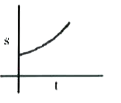
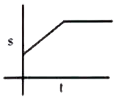
A particle moving along straight line has velocity `v = mu s` where s is in the displacement . If `s = s_0` then which of the following graph best represent s versus t

A

B

C

D

Text Solution

Verified by Experts

The correct Answer is:

C
Promotional Banner

Similar Questions

Explore conceptually related problems

A particle moves along a straight line its velocity dipends on time as v=4t-t^(2) . Then for first 5 s :

An object starts at the origin in a straight line. Its velocity versus time graph is shown in the figure. Which one of the following choices best gives the proper intervals (s) of time for which the object is moving away from the origin?

A particle is moving on a straight line. Its velocity at time t is (8-2t)m//s . What is the total distance covered from t=0 to t=6s ?

The speed(v) of a particle moving along a straight line is given by v=(t^(2)+3t-4 where v is in m/s and t in seconds. Find time t at which the particle will momentarily come to rest.

A particle moving in a straight line has velocity-displacement equation as v = 5 sqrt(1 + s). Here v is in ms^-1 and s in metres. Select the correct alternative.

The velocity 'v' of a particle moving along straight line is given in terms of time t as v=3(t^(2)-t) where t is in seconds and v is in m//s . The displacement of aprticle from t=0 to t=2 seconds is :

The velocity 'v' of a particle moving along straight line is given in terms of time t as v=3(t^(2)-t) where t is in seconds and v is in m//s . The distance travelled by particle from t=0 to t=2 seconds is :

A particle moving along a straight line with uniform acceleration has velocities 7 m//s at A and 17 m//s at C. B is the mid point of AC. Then :-

If the velocity v of a particle moving along a straight line decreases linearly with its displacement from 20 m//s to a value approaching zero at s = 30 m, determine the acceleration of the particle when s = 15 m.

If the velocity v of particle moving along a straight line decreases linearly with its displacement s from 20 ms^(-1) to a value approaching zero at s = 30 m, then acceleration of the particle at v=10ms^(-1) is
