Home
Class 11
BIOLOGY
The following graph depicts changes in t...

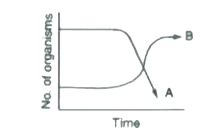
The following graph depicts changes in two populations A and B of herbivores in a grassy field. A possible reason for these changes is that

A

Popuation A consumed the members of population B

B

Both plant population in this habitat decreased

C

Population B competed more successfully for food than population A

D

Population A produced more offspring than population B

Text Solution

Verified by Experts

The correct Answer is:

C
Promotional Banner

Topper's Solved these Questions

  • ECOSYSTEM

    AAKASH SERIES|Exercise EXERCISE-II (ECOSYSTEM SERVICES)|11 Videos
  • CELL CYCLE AND CELL DIVISION

    AAKASH SERIES|Exercise Exercise-III|18 Videos
  • ENVIRONMENTAL ISSUES

    AAKASH SERIES|Exercise Exercise-III (Previous AIPMT/NEET Questions)|41 Videos

Similar Questions

Explore conceptually related problems

The following graph depicts changes in two populations (A and B) of herbivores in a grassy field. A possible reson for these changes is that

Which of the following graphs best depicts the changes in one cycle of PCR ?

Give the formula for the change in population size.

The accompanying figure depicts a change in concentration of species A and B for the reaction ArarrB , as a function of time. The point of inter section of the two curves represents

The following graphs (A and B) depicts changes in DNA Content during cell cycle. Identify the cell divison from A and B :-

Study the set-up shown in the diagram and answer the following: What change will you observe in part 'B' of the setup after one hour? Give reason for this change.

A population of horses is split into two population by a new river bed that forms after a flood. After many generations,the river changes course and the population mix again. Which of the following indicates that the two population have formed two separate species?

Given an example where physisorption changes to chemisorption with rise in temperature. Explain the reason for change.

Which of the following change is possible in aqueous medium -

If change in gene frequencies in a population occurs by chance, then it is called as:

AAKASH SERIES-ECOSYSTEM-EXERCISE-III (PREVIOUS AIPMT/NEET QUESTIONS)
  1. An association of individuals of different species living in the same ...

    Text Solution

    |

  2. Increase in concentration of the toxicant at successive trophic levels...

    Text Solution

    |

  3. The following graph depicts changes in two populations A and B of herb...

    Text Solution

    |

  4. Secondary Succession take splace on // in :

    Text Solution

    |

  5. In an ecosystem the rate of production of or- ganic matter during phot...

    Text Solution

    |

  6. The mass of living material at a trophic level at a particular time is...

    Text Solution

    |

  7. Vertical distribution of different species occupying different levels ...

    Text Solution

    |

  8. Rachel Carson's famous book "Silent Spring" is related to

    Text Solution

    |

  9. Match the following and select the correct option

    Text Solution

    |

  10. Secondary productivity is rate of formation of new organic matter by :

    Text Solution

    |

  11. Which one of the following processes during decomposition is correctly...

    Text Solution

    |

  12. Natural reservoir of phosphorus is

    Text Solution

    |

  13. Which one of the following is not a gaseous biogeochemical cycle in ec...

    Text Solution

    |

  14. Pheretima and its close relatives derive nourishment from

    Text Solution

    |

  15. Identify the possible link ''A'' in the following food chain Plant ...

    Text Solution

    |

  16. The upright pyramid of number is absent in :

    Text Solution

    |

  17. Which one of the following is not a functional unit of an ecosystem

    Text Solution

    |

  18. Given below is an imaginary pyramid of numbers. What could be one of t...

    Text Solution

    |

  19. Which one of the following statements for pyramid of energy is incorre...

    Text Solution

    |

  20. The mass of living material at a trophic level at a particular time is...

    Text Solution

    |
